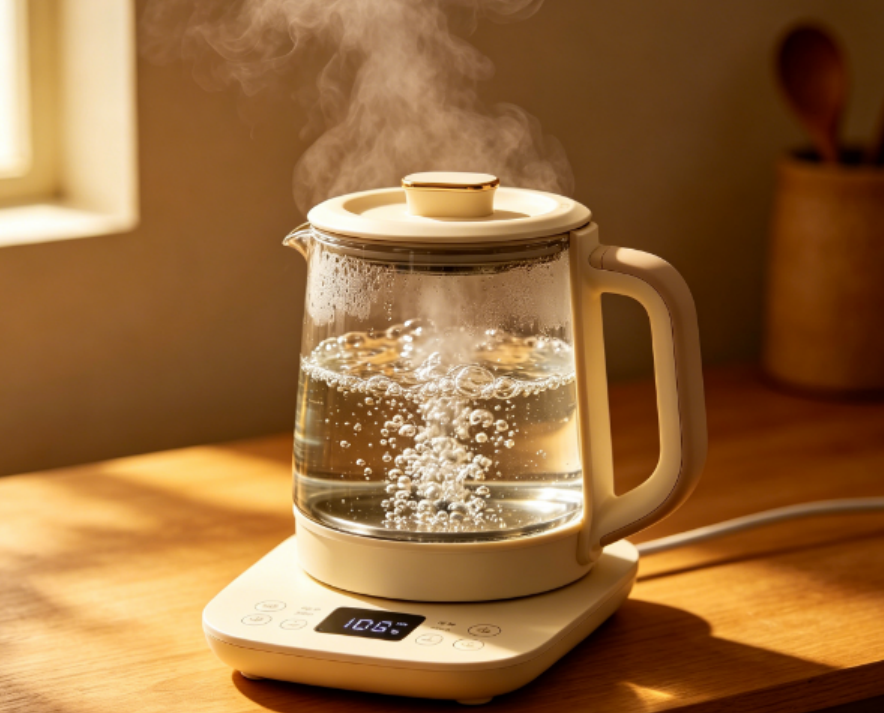
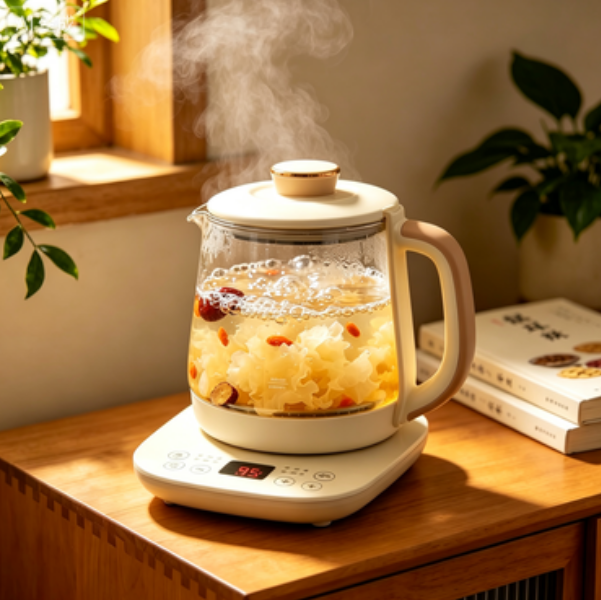
From health-promoting teas in the office to herbal teas in the home kitchen, health pots are becoming an increasingly popular "health partner" in both homes and offices. Today's health pots are no longer just upgraded versions of traditional kettles, they are intelligent cooking devices integrating multiple functions. Honey grapefruit tea, red date and longan soup, snow pear and white fungus soup—all seem effortless with just one button.
However, occasional complaints can be found in the reviews: "I set the chrysanthemum and goji berry tea to 85℃, but the temperature always felt off when I poured it into the cup," "I ordered white fungus soup the night before, but it was only lukewarm when I opened the lid this morning"... These feedback actually point to a core technological challenge of intelligent health pots—the accuracy of temperature sensing and control.
Temperature: The "Flavor Code" of Health Drinks
The gelatinization of white fungus soup requires a long, gentle simmer, but excessively high temperatures will thin the gelatinous substance. Honey water loses a significant amount of active enzymes once the temperature exceeds 60℃. During flower tea extraction, aromatic substances are released around 80℃, while bitter components are easily extracted above 90℃. Studies have shown that for every 5℃ change in water temperature, the dissolution rate of substances like tea polyphenols changes significantly. Each ingredient has its own optimal temperature profile.
Smart health pots need to flexibly switch between multiple modes, including boiling, stewing, constant-temperature extraction, and long-term heat preservation, and many usage scenarios involve unattended overnight stewing. If the temperature measurement is inaccurate or the response is slow, the "smart" aspect will be greatly diminished.
Infrared Thermopile Technology: Opening a New Perspective on Non-Contact Temperature Measurement
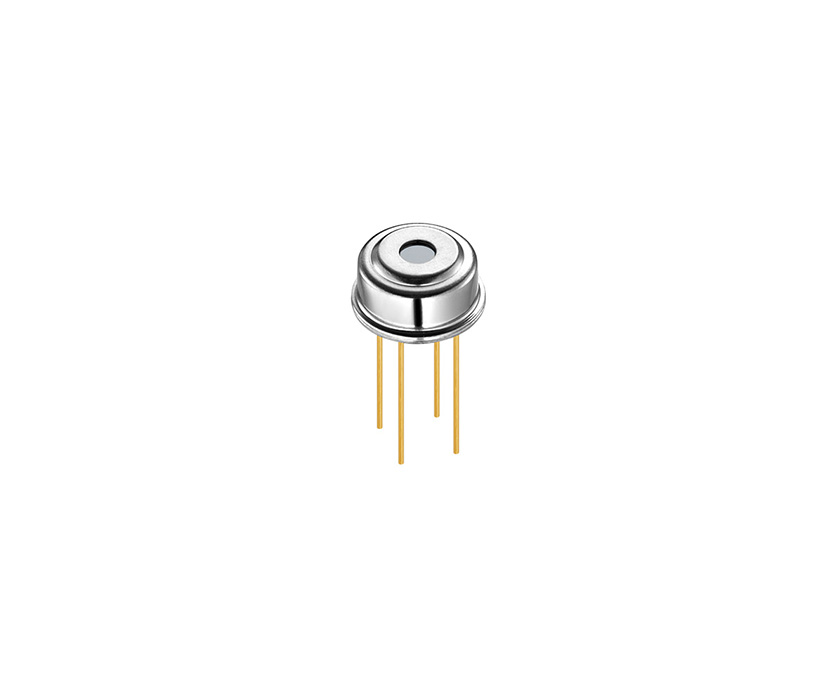
MFrontier's MTP10-A6F55D is a single-channel digital infrared thermopile sensor. It features a small TO39 metal package and integrates a thermopile temperature sensor, a programmable gain amplifier (PGA), an analog-to-digital converter (A/D), a digital signal processor (DSP), a multiplexer (MUX), and I²C communication protocol. Its core temperature measurement principle is based on the Seebeck effect: the sensor receives infrared energy radiated by an object through a thermocouple array, converts it into a voltage signal, and then directly outputs a digital temperature value after processing by an internal signal chain, all without physical contact with the object being measured.
Thanks to its high level of integration, manufacturers of health pots can directly read temperature data via the I²C bus without needing to design additional analog front-end circuitry, significantly reducing hardware development complexity and PCB space requirements.
Four Key Technical Features for Precise Adaptation to the Health Pot
Non-Contact Temperature Measurement for More Accurate Temperature Acquisition
The MTP10-A6F55D employs a completely non-contact temperature measurement principle. Unlike traditional sensors that require physical contact with the liquid, it calculates temperature by sensing the infrared energy radiated from the surface of the object. Simply install the sensor above the base of the health pot, sensing the infrared signal from the pot wall or liquid surface through the air to obtain accurate temperature in real time. It is no longer affected by limescale buildup, food residue, or sensor aging, completely avoiding the inherent limitations of traditional contact-based solutions.
62° Wide Field of View for Flexible Installation Without Precise Alignment
The sensor's 62° field of view allows for highly flexible installation within the health pot. Whether installed above the bottom of the pot to sense the temperature from above, or placed near the lid to view the liquid surface from above, it effectively captures infrared radiation from the target area without requiring close contact with the surface being measured, as is the case with contact-based solutions. This design significantly reduces the constraints of the overall structural design.
Low Power Consumption Mode, Zero Power Consumption in Standby Mode
Easy-to-use kettles spend a lot of time in keep-warm or standby mode, and power consumption directly affects product energy efficiency. The MTP10-A6F55D draws only 600μA in continuous operation mode and as low as 5.0μA in sleep mode, making it suitable for designs with power consumption requirements, especially for electric kettles that need to keep warm for extended periods.
Self-Developed Long-Pass Filter, Strong Anti-Interference Capability
During operation, the electric kettle experiences significant temperature differences between the inside and outside, and water vapor evaporation. Ambient light and short-wave infrared interference can affect the stability of infrared temperature measurement. The MTP10-A6F55D is equipped with a self-developed long-pass filter with an average transmittance of ≥80% in the 5.5~14μm band and a cutoff rate of 1% in the <5μm band. This effectively shields against short-wavelength infrared interference, ensuring stable and accurate temperature output even above a kettle filled with steam.
The Triple Value Brought to Health pots
1. Simplified System Architecture, Accelerated Product Development
Traditional non-contact temperature measurement solutions often require additional analog signal conditioning circuitry, involving multiple stages such as amplification, filtering, and A/D conversion, resulting in long development cycles and high calibration difficulty. The MTP10-A6F55D's all-digital output characteristic highly integrates the signal chain into a single chip, directly outputting digital temperature values. Health-preserving kettle manufacturers can quickly complete solution integration, allowing them to focus more on developing differentiated functions.
2. Adaptation to Diverse Functions, Enhancing the User's Brewing Experience
From slow-cooking to gelatinize white fungus soup to precise extraction of herbal teas, from double-boiling bird's nest to maintaining a constant temperature for beverages, the functions of health pots are becoming increasingly diverse. A highly integrated, wide-temperature-range infrared temperature sensor provides a unified and stable temperature control foundation for these differentiated functions.
3. Non-contact design results in a cleaner product appearance
Infrared temperature measurement eliminates the need for the sensor to be exposed inside the kettle body, allowing it to be completely hidden behind the structural components. This avoids potential hygiene blind spots and cleaning difficulties caused by the probe being immersed in liquid, and also makes the overall appearance more concise and aesthetically pleasing, enhancing the product's quality.
Conclusion
As consumers increasingly pursue a healthy lifestyle, the health pot is transforming from a basic small appliance into a kitchen companion integrating intelligence, health, and convenience. Accurate temperature sensing is an indispensable part of this transformation. The MTP10-A6F55D digital infrared thermopile sensor from MFrontier, with its high integration, wide temperature range, and low power consumption, provides a reliable sensing core for temperature measurement in smart appliances such as health pot, helping every pot of healthy beverage reach the perfect temperature.
Share