Gas sensing technology has become an "invisible guardian" for development across various sectors. It safeguards indoor air quality in consumer settings, optimizes exhaust emissions and enhances safety monitoring in the automotive industry, ensures process stability and prevents disasters in industrial production, assists medical diagnoses through the precise detection of respiratory gases, and protects the ecosystem by monitoring pollutants in real-time. From daily life to large-scale production, gas sensing technology—with its keen "sense of smell"—drives industries toward greater intelligence and safety. Below are ten common gas sensing methods.
The core principle of a PID (Photoionization Detector) involves using ultraviolet (UV) light to irradiate gas molecules, causing them to ionize and generate a detectable electric current signal. A typical PID sensor consists of a UV light source (UV lamp), an ionization chamber, an electrode system, a sampling system, and signal processing circuitry. PIDs are suitable for detecting volatile gases and vapors with ionization energies lower than the energy of the UV light; these primarily include volatile organic compounds (VOCs), ammonia (NH₃), hydrogen sulfide (H₂S), hydrogen cyanide (HCN), and phosphine (PH₃). PIDs play a vital role in industrial safety, chemical leak detection, monitoring fuel vapor emissions at gas stations, emergency response, and gas detection at the scenes of hazardous chemical accidents.
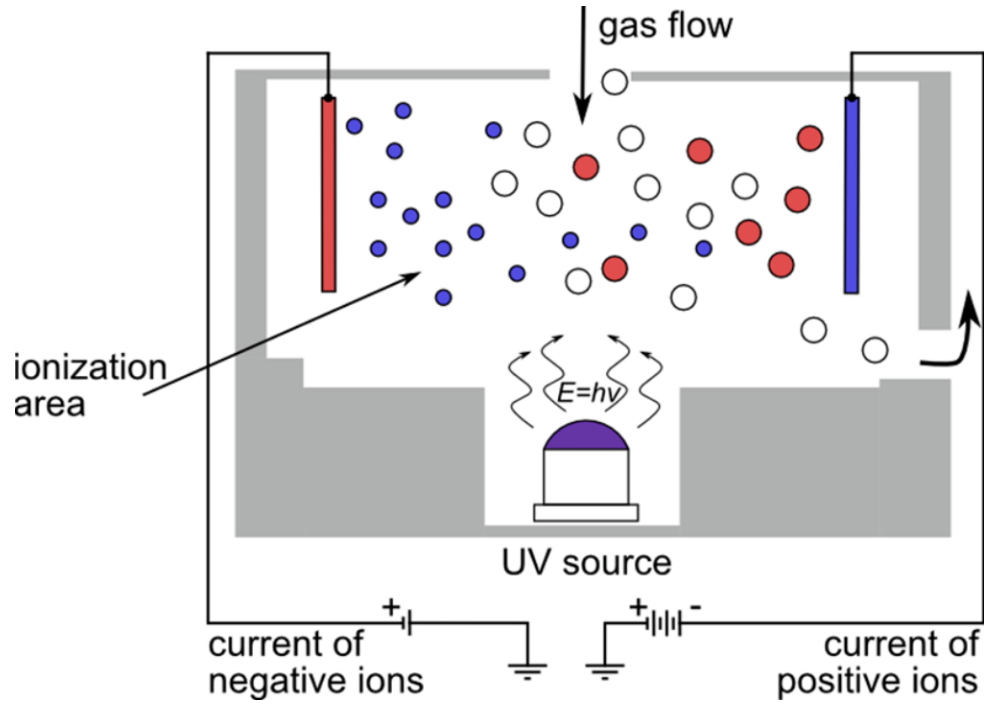
Figure: Principle of the PID gas sensor
This sensor utilizes the differences in thermal conductivity between gases, it employs a Wheatstone bridge configuration consisting of a sensing element (such as a platinum wire) and a reference element. When the target gas enters the sensing chamber, its thermal conductivity differs from that of air, causing a temperature change in the sensing element and unbalancing the bridge, this results in the output of a voltage signal proportional to the gas concentration. It is capable of detecting high concentrations of H₂ or CO₂, or specific components within a gas mixture (such as CH₄ in natural gas).
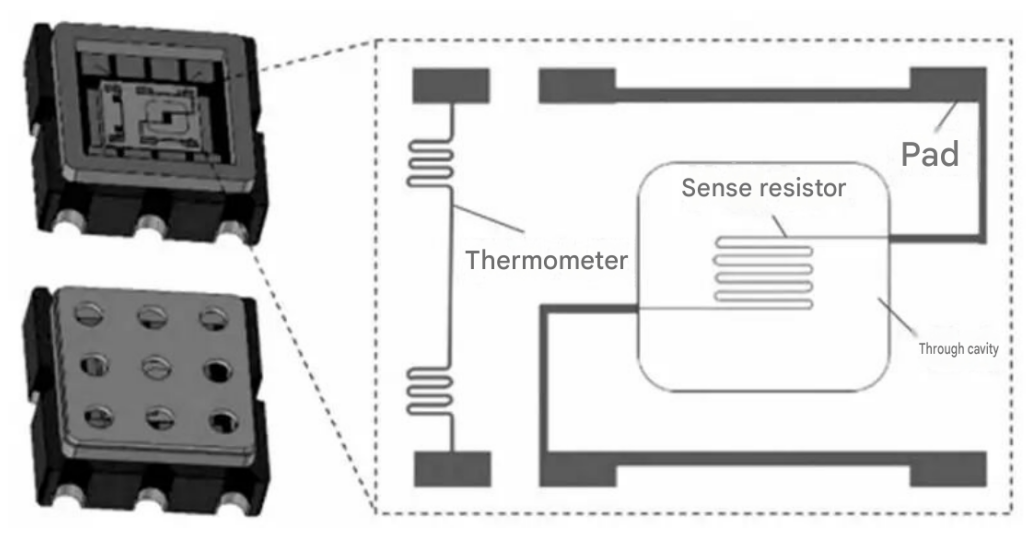
Figure: Schematic diagram of a thermal conductivity gas sensor and its circuit
This sensor operates based on the selective absorption of specific infrared wavelengths by gases (such as the absorption peak of CO₂ at 4.26 μm). It consists of an infrared light source, an optical filter, a gas chamber, and a detector. As the target gas absorbs infrared light at the specific wavelength, the intensity of the light reaching the detector decreases; the gas concentration is then calculated using the Beer-Lambert law. It is capable of detecting greenhouse gases or toxic gases such as CO₂, CO, and CH₄.
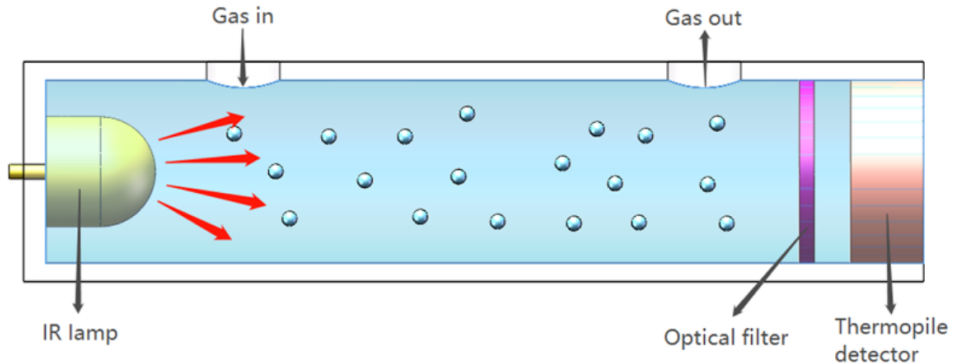
Figure: Structure and optical path of the NDIR sensor
Light interacts with gas either within the fiber core or near its surface, altering the light's intensity and phase and generating phenomena such as heat, acoustic waves, or new optical wavelengths; by detecting these changes, the gas type and concentration can be determined. For gases that exhibit strong absorption within the operating wavelength range, spectral loss or dispersion can be directly detected; alternatively, measurements can be based on photothermal or photoacoustic effects to detect phase changes in a probe beam induced by the gas absorbing pump light. For gases that exhibit weak or no absorption but possess Raman activity, Raman spectra, stimulated Raman gain, or dispersion can be detected. The sensing fiber may be a hollow-core photonic bandgap fiber, a hollow-core anti-resonant fiber, or a micro/nano-core fiber. A typical example of a device for detecting flammable, explosive (e.g., H₂), or corrosive gases is the ABB MBG series fiber-optic combustible gas detector.
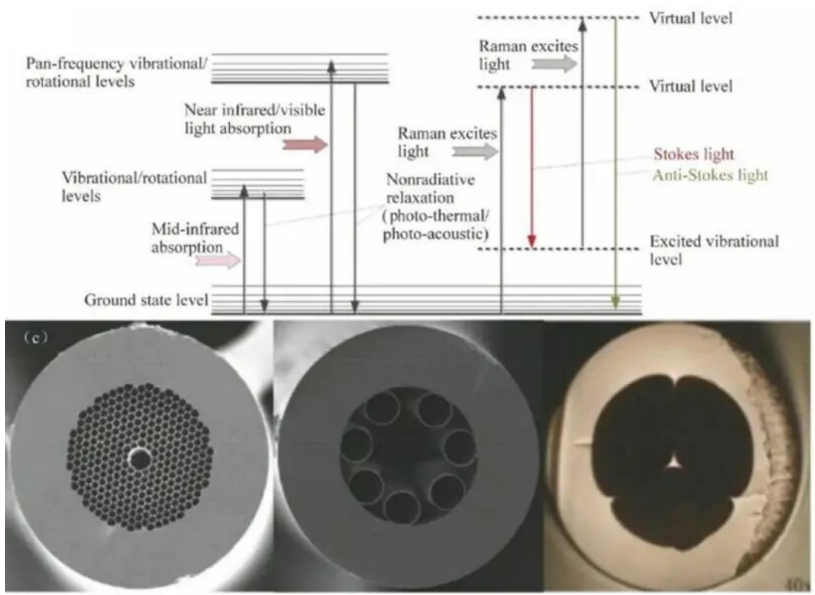
Figure: Physical processes of the fiber-optic gas sensor and the optical fiber
Interdigital transducers (IDTs) are fabricated on a piezoelectric substrate (such as quartz or LiNbO₃) to excite surface acoustic waves. The substrate surface is coated with a sensitive film (e.g., a polymer or metal oxide); when the target gas is adsorbed, changes in the film's mass or conductivity cause a shift in the SAW propagation velocity or frequency, allowing gas concentration to be determined by measuring the frequency change. Typical applications include the detection of low-concentration gases such as VOCs, NH₃, and H2S.
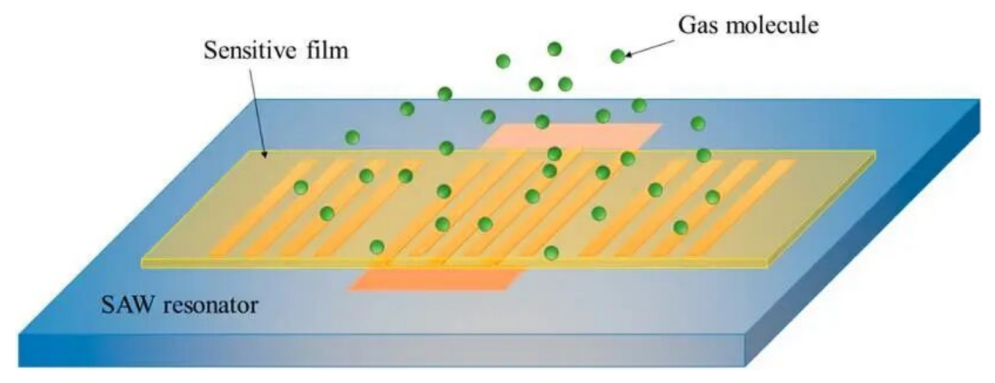
Figure: Schematic diagram of the SAW gas sensor structure
When gas absorbs laser light at a specific wavelength, molecules release heat through non-radiative transitions, causing local gas expansion that generates acoustic waves. A high-sensitivity microphone detects these acoustic signals, with the sound intensity being directly proportional to the gas concentration. PAS sensors primarily consist of a light source, a photoacoustic cell, a detector, and signal processing circuitry; the photoacoustic cell—typically a sealed chamber filled with the target gas—is where the photoacoustic signal is generated. Factors such as the cell's shape, dimensions, and material influence the intensity and quality of the photoacoustic signal. Typical applications include trace gas detection (e.g., CO, CO₂, and CH4) and industrial process monitoring.
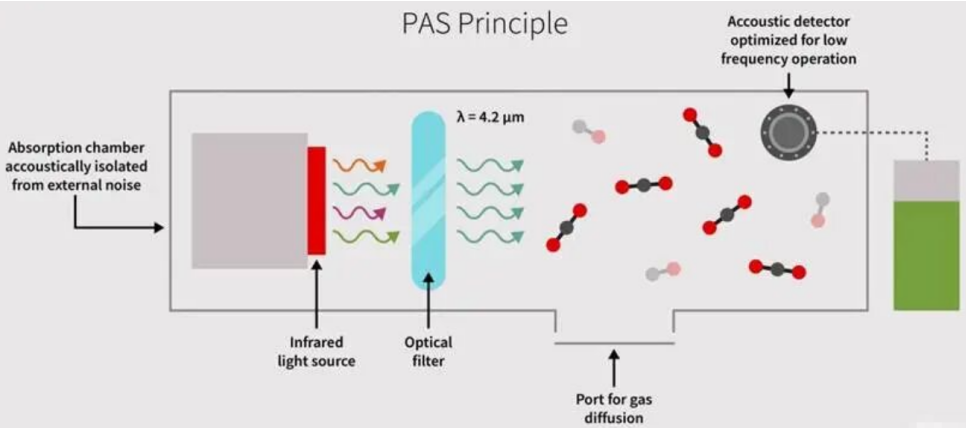
Figure: Structure and operating principle of a photoacoustic spectroscopy gas sensor
Laser-based gas sensors include Tunable Diode Laser Absorption Spectroscopy (TDLAS) and Cavity Ring-Down Spectroscopy (CRDS) systems. TDLAS is based on the Beer-Lambert law; it employs a semiconductor laser to scan the characteristic absorption peak of a target gas (such as CH₄ at 1.65 μm) and calculates concentration by measuring the attenuation of laser intensity, offering high resolution and strong interference immunity. In CRDS, the laser undergoes multiple reflections within a high-reflectivity optical cavity (reflectivity > 99.99%), and gas absorption causes the light intensity to decay exponentially; gas concentration is determined by measuring the ring-down time (the time required for light intensity to decay to 1/e of its initial value), achieving sensitivity at the ppb level.
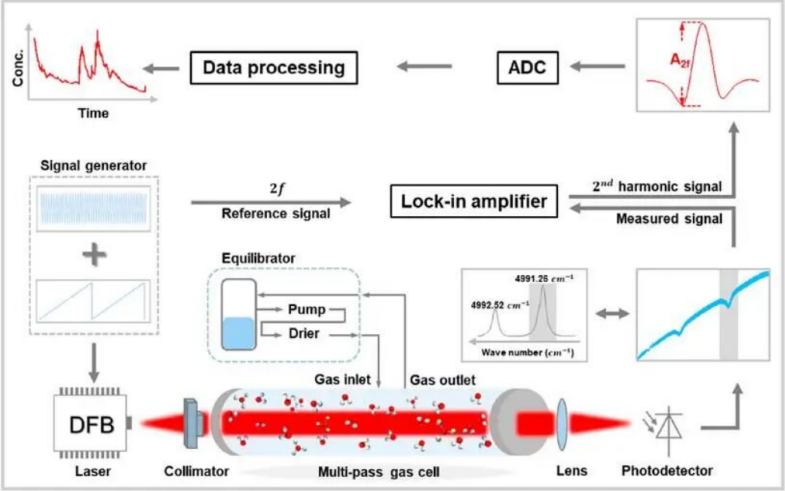
Figure: Principle and structure of Tunable Diode Laser Absorption Spectroscopy (TDLAS)
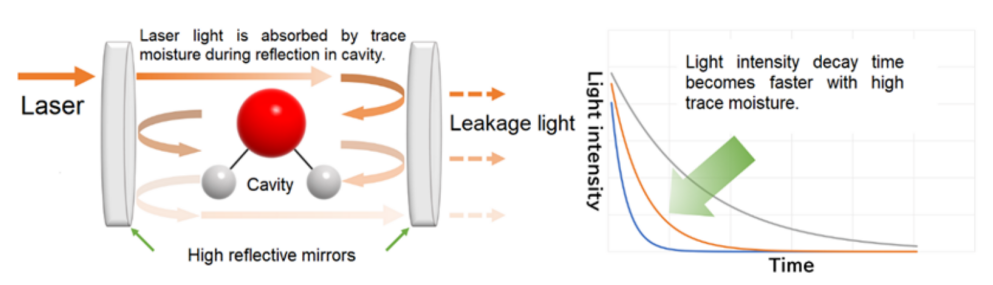
Figure: Optical cavity structure for Cavity Ring-Down Spectroscopy (CRDS)
These sensors operate based on redox reactions occurring on the surface of metal-oxide semiconductors (such as SnO₂ or ZnO). When a target gas (e.g., a reducing gas like CO or H₂) adsorbs onto the heated metal-oxide surface, electron transfer takes place, causing a change in the material's electrical conductivity. For instance, when SnO₂ adsorbs CO at high temperatures, the CO is oxidized to CO₂ and releases electrons, thereby increasing the conductivity of the n-type semiconductor. Typical applications include the detection of combustible or toxic gases such as CO, CH₄, alcohol, and formaldehyde.
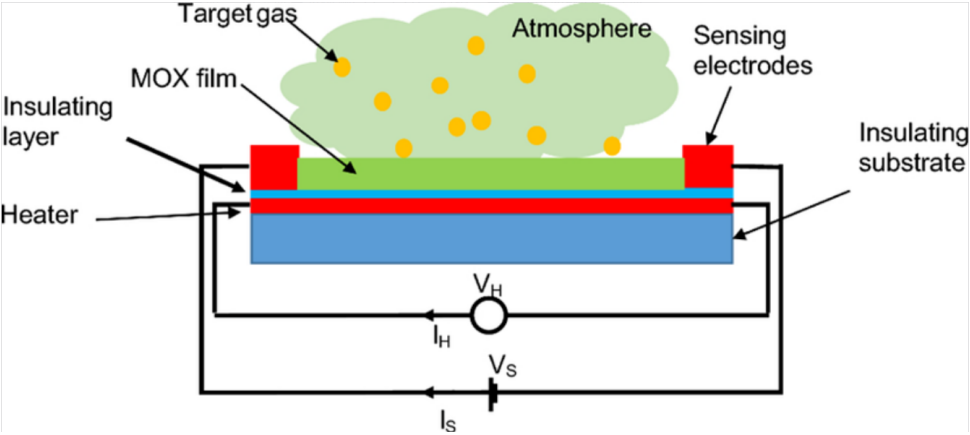
Figure: Structure of a metal oxide gas sensor
Combustible gases undergo catalytic combustion on the surface of a catalyst (such as platinum or palladium), releasing heat that increases the resistance of a temperature sensor (such as a platinum resistor). Gas concentration is detected by measuring this change in resistance. These sensors typically employ a Wheatstone bridge configuration, with a reference element used for temperature compensation. Typical applications include the detection of combustible gases such as methane, propane, and hydrogen; they are widely used in industrial safety and gas leak monitoring.
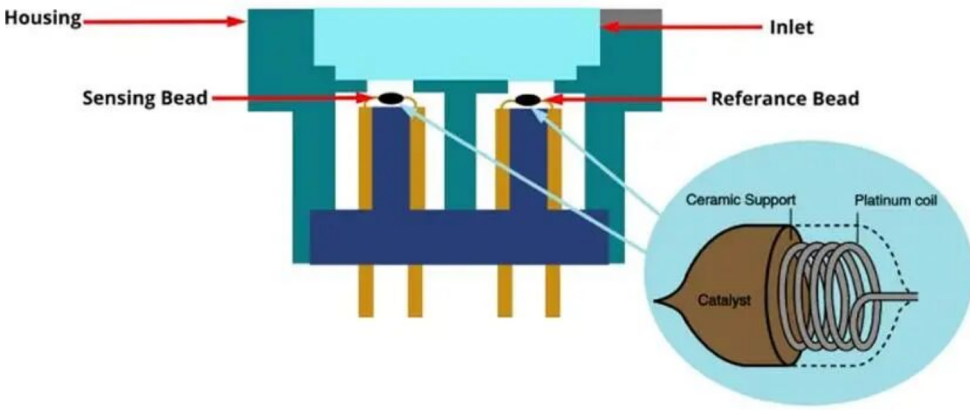
Figure: Structure of a catalytic combustion sensor
Commonly used electrochemical gas sensors primarily include constant-potential electrolytic sensors and galvanic cell sensors. The constant-potential electrolytic type operates by applying a constant voltage to drive a gas reaction at the electrode (such as the oxidation of CO at the working electrode); the resulting current is proportional to the gas concentration, making it suitable for detecting reducing gases (e.g., CO, H₂S). The galvanic cell type operates based on a spontaneous redox reaction of the gas at the electrode, generating a current proportional to the concentration. For instance, in an oxygen sensor, O2 is reduced at the cathode while lead is oxidized at the anode, with the current magnitude directly reflecting the O₂concentration. Typical applications include the detection of oxidizing gases such as O₂, Cl₂, and SO₂.
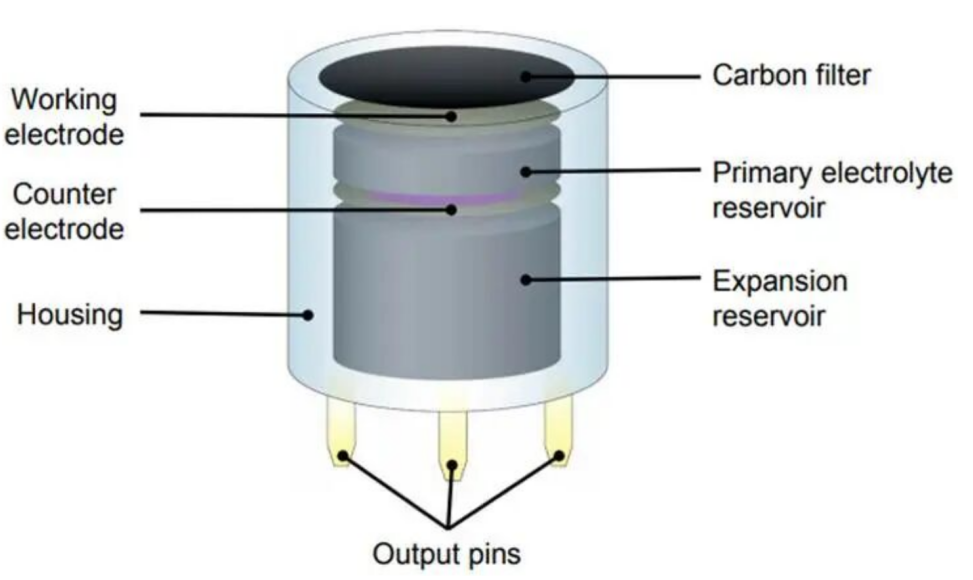
Figure: Schematic diagram of an electrochemical gas sensor.
Share