NDIR (Non-Dispersive Infrared) technology has become the mainstream method for detecting carbon dioxide concentration, playing a crucial role in environmental monitoring, smart agriculture, and industrial safety. Its excellent selectivity and stability stem from a precisely coordinated technical system. To understand why NDIR sensors are so accurate, it's essential to understand how the five key technological pillars behind it are interconnected, transforming abstract optical principles into reliable data in our hands.
I. Technological Foundation: NDIR Working Principle
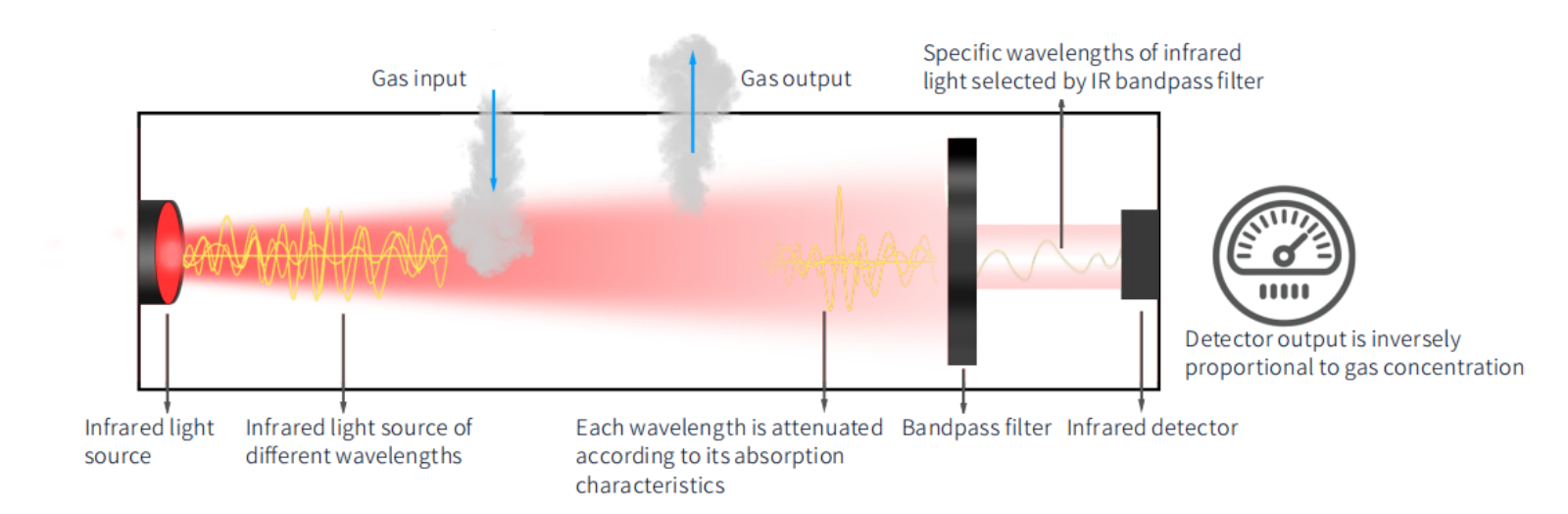
NDIR technology is based on molecular spectroscopy, and its core principle is the Lambert-Beer law. This law quantitatively describes the relationship between gas concentration and infrared light absorption: I = I₀·e^(-α·C·L), where I is the transmitted light intensity, I₀ is the incident light intensity, α is the absorption coefficient, C is the gas concentration, and L is the optical path length. Each gas molecule has a unique infrared absorption peak; for CO2, the strongest absorption peak is located at a wavelength of 4.26 μm. By measuring the degree of attenuation of infrared light at this characteristic wavelength after passing through the gas chamber, the CO2 concentration can be accurately determined.
II. In-Depth Analysis of Five Core Technology Modules
1. Infrared Light Source Technology: The Energy Heart of the System
In NDIR sensors, the infrared light source is the starting point of the detection signal, and its performance directly determines the intensity and stability of the output signal. Currently, infrared light source technology mainly develops along two paths.
One type is thermal radiation light sources. Traditional types, such as nickel-chromium alloy filament light sources, radiate broad-spectrum infrared light through current heating. Although the cost is low, they have disadvantages such as large size, high power consumption, and generally poor stability. The improvement direction for this is miniaturization: MEMS (Micro-Electro-Mechanical Systems) infrared light sources, manufactured using MEMS technology, are significantly smaller in size, and through precise power supply and temperature control design, have achieved significant improvements in response speed and long-term stability.
The other type is semiconductor light sources, represented by infrared light-emitting diodes (LEDs). They emit light directly through the recombination of electrons and holes in semiconductor materials, and have outstanding advantages such as fast response, low power consumption, and long lifespan. For CO₂ detection, the key is to select an infrared LED that can accurately emit a wavelength of 4.26 μm (the characteristic absorption peak of CO₂). By stabilizing the driving current and combining wavelength locking technology and temperature compensation circuits, the high stability of the output optical power can be ensured, laying the foundation for subsequent high-precision detection.
2. Optical Filtering System: The Precise Signal Filter
In NDIR sensors, accurately "capturing" only the characteristic absorption peak of CO₂ (approximately 4.26 μm) from the broad infrared spectrum is crucial for eliminating interference from other gases and ensuring measurement accuracy. This is mainly achieved through the following two types of precision optical filtering technologies:
Among them, interference filters are the most widely used selective "optical sieve." Based on the principle of light interference, they are made of dozens of layers of dielectric thin films with different refractive indices stacked alternately. When infrared light passes through, only light of the target wavelength (such as 4.26 μm) will have its intensity superimposed due to interference and pass through smoothly, while light of other wavelengths will cancel each other out and be blocked. By precisely controlling the thickness and material of each film layer, filters with extremely precise center wavelengths and very narrow passbands can be customized, perfectly matching the "spectral fingerprint" of CO₂.
In complex environments where other interfering gases such as water vapor are present, more advanced Gas Filter Correlation (GFC) technology demonstrates unique advantages. It can be considered a "dynamic ruler" for dealing with cross-interference. Its core principle lies in setting up a reference chamber filled with a pure reference gas (such as nitrogen). The system simultaneously compares two beams of light: one passing through the measurement chamber (containing the gas to be measured) and the other through the reference chamber. Because the gas composition in the reference chamber is constant, any difference in the intensity of the two light beams can be accurately attributed to the absorption of CO₂ in the measurement chamber, thus effectively eliminating overlapping interference from background gases and significantly improving detection reliability in complex working conditions.
3. Gas Chamber Structure Design: The Interaction Field of Light and Gas
In NDIR sensors, the gas chamber is the key sensitive component for gas detection, and its design requires finding the optimal balance between detection sensitivity and overall size.
In the simplest direct-transmission gas chamber, infrared light passes directly through the gas to the detector. While this structure is simple and reliable, increasing sensitivity requires increasing the length of the gas chamber, which often leads to an excessively large device size. Therefore, to achieve high-sensitivity detection within a limited space, innovation in the structure and materials of the gas chamber is necessary.
Optical path enhancement technology is central to solving this contradiction. Reflective gas chambers, through the careful arrangement of highly reflective optical mirrors inside, allow light to be reflected multiple times as if in a maze, thereby extending the effective detection optical path by several or even tens of times without increasing the external dimensions. The typical White cell structure is an outstanding example of this technology, significantly enhancing the absorption of infrared light by CO₂, and greatly improving the detection capabilities of small-volume sensors.
At the same time, the selection of gas chamber materials is also crucial. Window materials need to possess excellent infrared transmittance and chemical stability, such as zinc selenide (ZnSe) or sapphire. These materials minimize energy loss as infrared light passes through and prevent chemical reactions with gases such as CO₂, thus ensuring the accuracy and reliability of long-term detection.
Simply put, modern gas chamber design combines ingenious optical structures with advanced materials to create an efficient and stable gas detection environment within a small space.
4. Infrared Detector: The Bridge of Photoelectric Conversion
In NDIR detection systems, the infrared detector plays a crucial role as the "signal receiver," responsible for converting the infrared light signal, which has passed through the gas chamber and been absorbed by CO₂, into an electrical signal that can be analyzed. The specific type of detector chosen depends primarily on the requirements of the actual application scenario.
Currently, common infrared detectors are mainly divided into two categories: thermal detectors and photon detectors.
Thermal detectors, represented by pyroelectric detectors and thermopile detectors, both operate based on temperature changes. Pyroelectric detectors utilize the pyroelectric effect of certain crystalline materials: when the absorption of infrared light causes a temperature change, a change in charge occurs on the material's surface, producing an electrical signal. Thermopile detectors are based on the Seebeck effect, measuring the thermoelectromotive force generated by multiple thermocouples connected in series due to heating to sense the infrared light intensity. The common advantages of these detectors are that they do not require cooling, have a robust structure, and are relatively inexpensive, making them a mainstream choice in commercial sensors; however, their response speed is usually slower, which to some extent limits the rapid response capability of the entire detection system.
Photon detectors, such as mercury cadmium telluride (HgCdTe) detectors, belong to a more advanced detection technology. They operate based on the photoelectric effect, where internal electrons directly absorb infrared photons and are excited to generate an electrical signal. These detectors have extremely high sensitivity and very fast response speeds, capable of accurately capturing weak light signal changes, showing significant advantages in fields requiring high precision and real-time performance (such as high-precision environmental monitoring or real-time industrial process control). However, their high performance usually depends on a low-temperature cooling environment (such as liquid nitrogen cooling), which undoubtedly increases the complexity and cost of the entire system, and therefore they are mostly used in laboratories or high-end professional equipment.
5. Signal Processing and Intelligent Algorithms: The Data Refinery
From raw signals to precise concentration values, multiple processing steps are required:
Front-end processing: A low-noise amplifier amplifies the detector output signal to increase signal strength; a band-pass filter is used to filter out noise outside a specific frequency range, retaining the signal frequency band related to CO₂ absorption. Lock-in amplification technology is used to accurately extract the useful signal from a complex noise background by synchronizing with the frequency of the modulated light source.
Concentration Inversion Algorithm: A gas concentration inversion algorithm is constructed based on the Lambert-Beer law. The algorithm is optimized to account for the nonlinearity of CO₂absorption characteristics and the influence of environmental factors (temperature, pressure, etc.).
Intelligent Algorithm Integration: Polynomial fitting or piecewise linearization methods are used to address the absorption saturation problem at high CO₂concentrations; digital filtering algorithms such as Kalman filtering are employed to optimize the signal in real time, improving the accuracy and stability of concentration calculations; artificial intelligence algorithms such as neural networks are utilized to build a more accurate CO₂ concentration prediction model by learning and training on a large amount of experimental data, adapting to complex and variable detection environments.
NDIR detection technology, through the deep synergy of key technologies such as infrared light sources, optical filtering, gas chamber design, infrared detectors, and signal processing algorithms, has become a reliable cornerstone in the field of CO₂ concentration measurement. It not only helps us accurately map the distribution of CO₂ in the environment but also provides solid support for the safe and efficient operation of industrial production and the intelligent control of indoor air quality.
Looking ahead, with the continuous progress of materials science, micro-nano manufacturing, and artificial intelligence algorithms, NDIR technology is evolving towards higher precision, smaller size, and greater intelligence. This technology will also take root and grow in a wider range of applications, contributing quietly but crucially to protecting ecological balance and creating a healthy and comfortable living environment.
Share