The selection of spectral bands for flame detectors is not an arbitrary process; rather, it is driven by a core objective: to ensure a rapid response to actual flames while minimizing false alarms caused by environmental interference—such as sunlight, heat sources, or artificial lighting. To achieve this, several common spectral combination strategies are employed.
Before determining a combination, one must understand the characteristic spectral bands of flame radiation, which serve as the foundation for all configurations:
Ultraviolet (UV) Band: Typically 185–260 nm. This range falls within the "solar-blind" region, where solar radiation reaching the ground is extremely weak. Consequently, it offers a high signal-to-noise ratio and enables an exceptionally fast response to flames.
Infrared (IR) Band: Flames—particularly those resulting from the combustion of hydrocarbons—exhibit a strong CO2 emission peak at 4.3–4.5 μm. This serves as the primary "fingerprint" for identifying a flame.
Reference Infrared Bands: Bands such as 3.8 μm and 5.3 μm are not unique to flames; instead, they function as background references. By comparing signal ratios, these bands help filter out interference from non-flame heat sources.
Based on the core bands mentioned above, several mainstream configuration strategies have emerged:
1. Single-Band UV or Single-Band IR: This is the most fundamental and cost-effective detection approach. A single-band UV detector typically utilizes a specific ultraviolet range (such as the 185–260 nm solar-blind region). While it offers extremely fast response times and high sensitivity, it is highly susceptible to interference from sunlight, lightning, electric welding arcs, as well as airborne dust or moisture. This type is generally reserved for applications where cost is a primary concern or for indoor environments free from intense light interference. Single-band infrared (IR) detection typically targets specific infrared emission peaks associated with flames (such as 4.3μm or 4.5μm). Its advantages include strong penetration through smoke and high resistance to interference from visible light; however, when used alone, it is highly susceptible to false triggers caused by blackbody radiation from high-temperature sources (e.g., industrial furnaces or human bodies). In short, while the single-band approach features a simple architecture, it offers limited resistance to interference and carries a relatively high false-alarm rate.
2. Dual-band infrared (IR2): To address the vulnerability of single-band systems to background heat sources, the dual-band infrared approach was developed. It generally employs a configuration consisting of a "flame-detection IR channel" and a "reference IR channel." The flame-detection channel (targeting, for instance, the 4.3μm or 4.5μm CO2 emission peak) captures flame signals, while the reference channel (e.g., 3.8μm or 5.3μm) monitors the ambient infrared background. By comparing the signal ratios between these two channels, the system can effectively filter out interference from high-temperature blackbody radiation (such as sunlight or heaters). Compared to single-band systems, IR2 significantly reduces the false-alarm rate and is widely adopted in commercial fire alarm devices. Typical wavelength combinations include 4.3μm + 3.8μm or 4.3μm + 5.3μm.
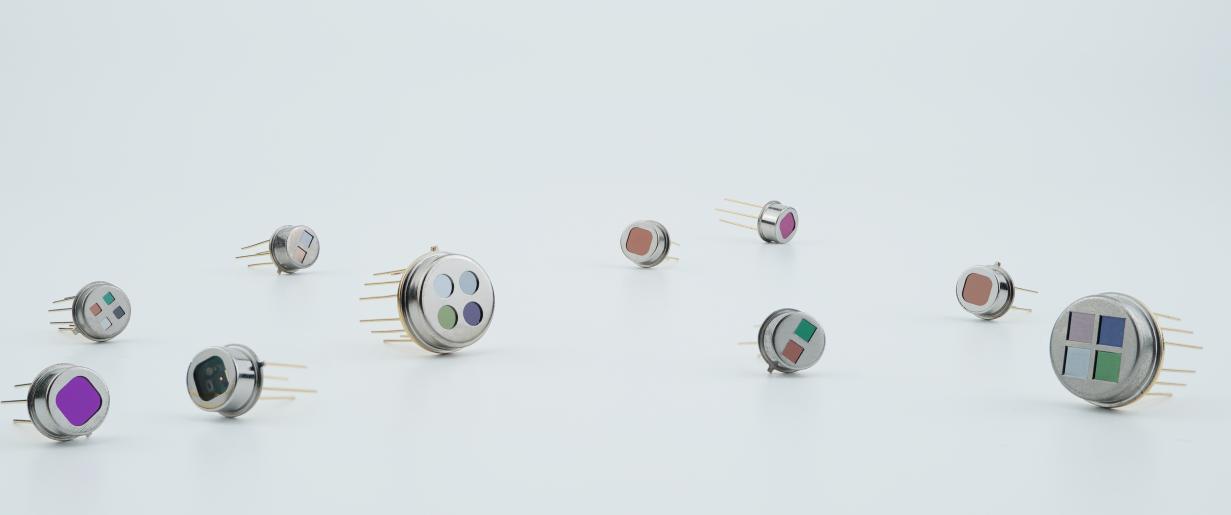
3. Triple-band infrared (IR3): This configuration—comprising one flame-detection IR channel and two reference IR channels—is a classic and widely utilized solution in industrial infrared detection. It employs a primary sensor (typically tuned to the 4.3μm/4.5μm CO2 peak) to detect flames, while two additional sensors (e.g., at 3.8μm and 5.3μm) serve as background references. Through sophisticated algorithms, the system analyzes the ratios and interrelationships of the signals across these channels. By further incorporating the characteristic flicker frequency of flames (typically 1–20 Hz) into its assessment, the system can effectively eliminate interference from stable heat sources, such as sunlight or high-temperature objects. A typical combination is 3.8μm + 4.3μm/4.5μm + 5.3μm.
4. Quad-band Hybrid (UV/IR2): This configuration—comprising two IR bands and one UV band—leverages the strengths of both infrared and ultraviolet detection. It builds upon a standard infrared reference set (such as 3.8μm, 4.3μm, and 5.3μm) by adding a UV sensor. This allows the system to utilize infrared bands for precise material identification and background suppression, while simultaneously employing the UV band for a faster initial response—an ideal solution for applications that demand both speed and reliability. A common example is the "dual-IR, single-UV" setup, consisting of two infrared bands (4.3μm, 5.3μm) and one ultraviolet band (185–260nm).
5. Multi-band Hybrid (UV/IR3): This configuration—three IR bands plus one UV band—represents a high-end solution designed for the most demanding environments. It integrates a UV sensor into a robust three-band infrared (IR3) foundation. By capturing signals simultaneously across four independent spectral channels and applying sophisticated multi-parameter algorithms for cross-verification, this configuration offers superior interference immunity. It can effectively distinguish real flames from common sources of interference, such as electric welding arcs or solar radiation.
In summary, the evolution of spectral band combinations has progressed from "single-feature identification" toward "multi-dimensional feature cross-verification." From simple UV+IR dual-confirmation and three-band infrared systems—which use reference bands to establish a logical closed loop—to advanced hybrid configurations that fuse the rapid response of UV with the precision of IR, each increase in the number of spectral bands serves a fundamental purpose: enabling the detector to "intelligently" discern genuine flames within complex industrial or outdoor environments.
Share