Falls are the leading cause of accidental injury among the elderly. According to the World Health Organization, approximately 684,000 people worldwide die from falls each year, with those over the age of 60 accounting for more than half of these cases. Within the home, bathrooms and restrooms are the most common locations for falls; slippery floors, cramped spaces, and the sudden physical exertion required when standing up can all serve as triggers for an accident.
Even more dangerous than the fall itself is the prospect of it going unnoticed. If an elderly person living alone slips in the bathroom and is unable to get back up, the delay in receiving help can lead to irreversible, life-altering consequences. Yet, bathrooms, restrooms, and bedrooms are precisely the places where cameras should not be installed—creating a persistent dilemma: how to ensure safety in private spaces without compromising privacy through surveillance.
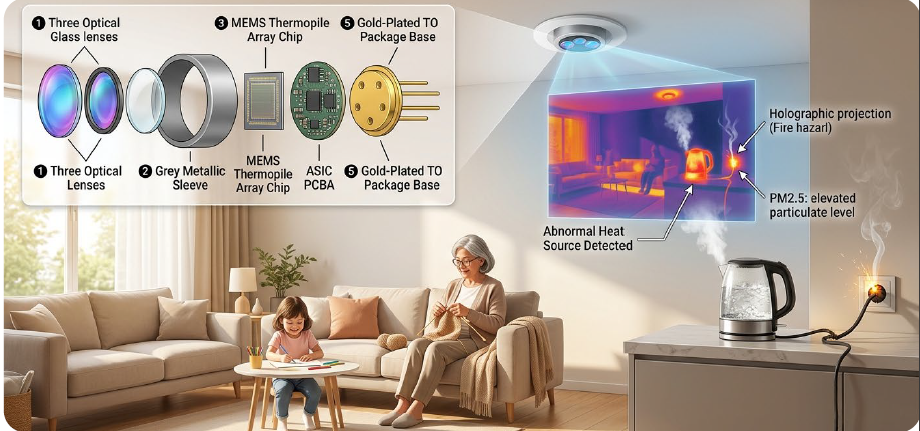
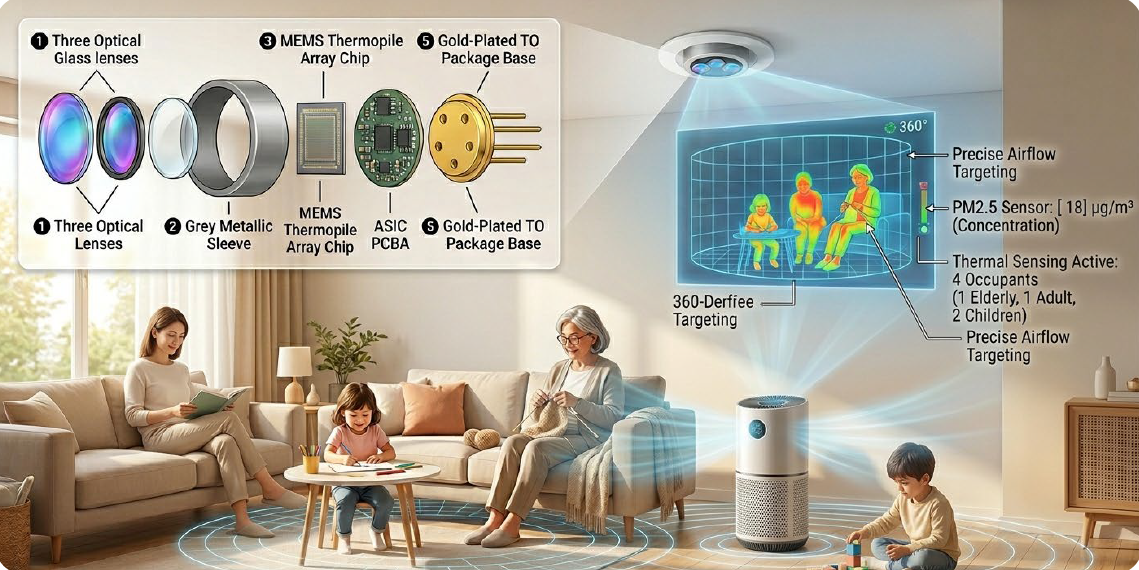
MFrontier offers a solution for fall detection in private spaces that ensures safety without the need for cameras, utilizing non-contact thermal imaging technology based on MEMS infrared thermopile arrays.
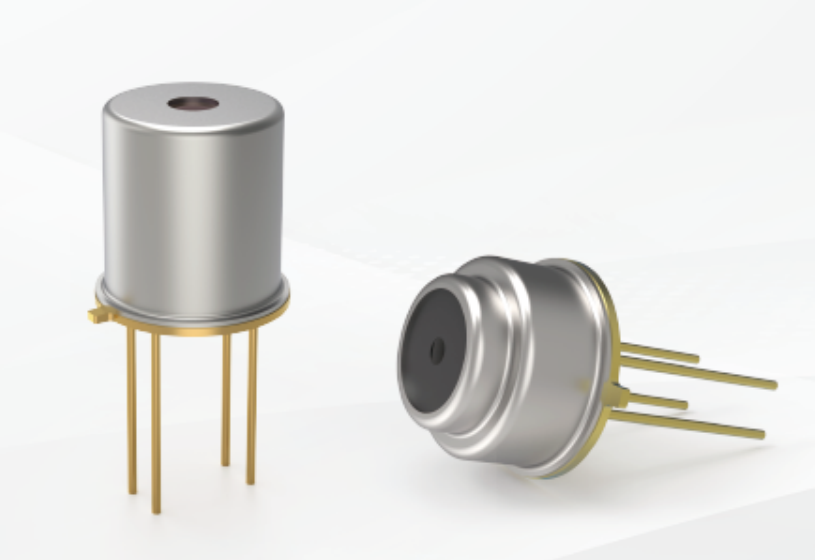
Traditional fall-detection solutions often rely on cameras—which offer high accuracy but compromise privacy—or millimeter-wave radar, which struggles to identify stationary targets. Wearable devices, meanwhile, depend on the user to actively wear them. By focusing on the dimension of "temperature," thermopile array-based solutions offer a technical approach that balances both accuracy and privacy.
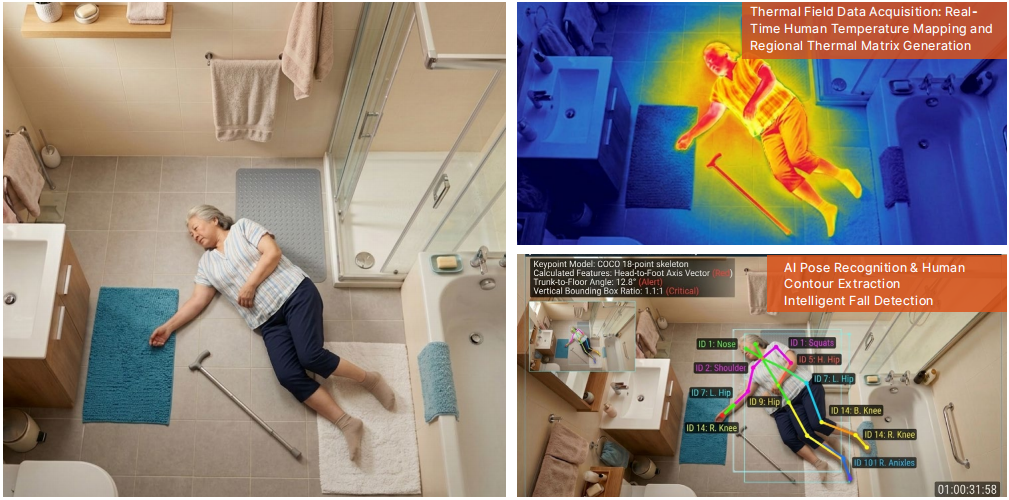
By collecting data on the distribution of human thermal fields within a space and utilizing target recognition and posture analysis algorithms, the system detects falls in private areas such as bathrooms, restrooms, and bedrooms. The sensor does not capture any visible-light imagery; instead, it outputs a temperature distribution matrix. While it can determine the location, posture, and any abnormal lack of movement of a person, it never records any identifiable visual footage. This approach ensures robust protection of personal privacy while enabling real-time monitoring of posture changes, abnormal stillness, and falls—triggering timely alerts to provide reliable safety oversight for elderly individuals living at home, those in smart healthcare/assisted living facilities, and people living alone.
Rich Data Acquisition: Captures regional temperature distribution, perceives human contour features, determines distance, and estimates changes in vital signs.
Advanced Processing Algorithms: Analyzes human contours and thermal fields to identify individuals; highly adaptable to various environments, with precise differentiation between human subjects and the background.
Versatile Connectivity and Ecosystem Compatibility: Supports communication interfaces such as I²C and UART, with options for wireless expansion, facilitating seamless integration into existing systems.
Ultra-Low Power Design: Employs passive infrared sensing with no active emissions; supports battery-powered operation.
Fall Early Warning: Accelerating Emergency Response
The system rapidly identifies fall risks and actual falls, triggering immediate alerts—notifying family members, community platforms, or emergency call systems—to significantly shorten the time between a fall and the arrival of assistance.
Privacy-First Protection: Safeguarding Dignity in Private Spaces
Utilizing non-contact thermal imaging, the system requires no cameras and generates no visual images, making it ideal for deployment in private areas like bathrooms, restrooms, and bedrooms. Elderly individuals need not worry about being "watched," and families need not fear privacy breaches; safety monitoring is provided without compromising personal dignity.
Round-the-Clock Protection: 24/7 Continuous Monitoring
Based on passive infrared sensing with no active emissions, the system’s ultra-low power design allows for battery operation and long-term, stable performance. Whether day or night, occupied or vacant, the system remains constantly active, providing 24/7 safety monitoring for those living alone.
The best form of protection is one that exists within the most private of spaces, operating in a manner that is entirely unobtrusive. Centered on non-contact thermal imaging sensing and posture analysis algorithms, MFrontier’s infrared thermopile array solution eliminates the need for cameras in fall detection—ensuring that safety monitoring in private spaces no longer has any blind spots.
Share