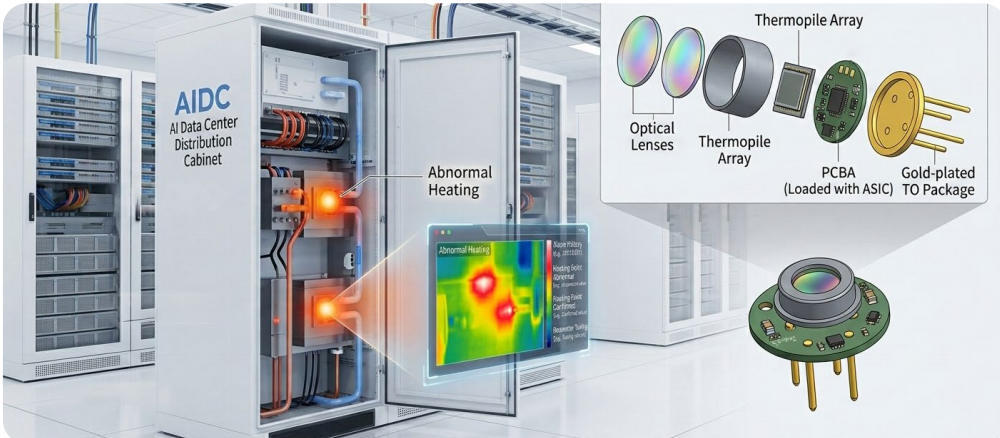
AI Data Centers are expanding at an unprecedented pace. The intensive deployment of clusters for large-model training and inference keeps power distribution systems in server rooms under high loads for extended periods. Within power distribution cabinets, critical components—such as busbars, terminals, circuit breakers, and cable connectors—operate under continuous high current. This environment can lead to issues like uneven branch currents, terminal aging, oxidation at connection points, and busbar overheating. If left unaddressed, these hazards can escalate into short circuits, tripped breakers, or even fires.
The most challenging aspect of these issues is that they often remain invisible. Traditional temperature monitoring in power distribution cabinets relies on manual inspections and single-point NTC (Negative Temperature Coefficient) sensors. Manual checks are periodic, prone to blind spots, and often reactive; meanwhile, NTC probes only capture temperatures in their immediate vicinity, leaving many heat-prone components unmonitored. By the time operations and maintenance (O&M) personnel detect an anomaly, a failure has usually already occurred, forcing teams to shift from proactive prevention to emergency repair.
Designed specifically for AIDC power distribution environments, thermopile array modules utilize non-contact, area-based infrared thermography. Installed within the cabinets, these modules provide 24/7 monitoring, capturing the complete thermal field distribution across critical areas, including busbars, terminals, circuit breakers, and cable connectors.
Unlike traditional single-point NTC sensors, thermopile arrays generate a 2D temperature matrix. This allows for the precise identification of localized temperature increases, latent "hot spots," and abnormal temperature differentials. By covering all heat-prone components within the cabinet, this technology fundamentally eliminates monitoring blind spots. The thermal status of every terminal, busbar segment, and connection point is rendered clearly visible in a single thermal map.
The module is equipped with a dedicated thermal anomaly analysis algorithm that tracks the rate of temperature rise, regional temperature differentials, and maximum temperature thresholds in real time. It supports multiple monitoring modes:
· High-Temperature Warning: Triggers an immediate alert when the temperature at critical points exceeds safe thresholds.
· Temperature Differential Warning: Triggers an alert when abnormal temperature gaps occur between adjacent areas or different locations on the same component.
· Gradual Heat Accumulation Warning: Identifies subtle, slow-rising temperature trends, capturing early signs of equipment aging, loose electrical connections, or overheating due to overloads.
The system can integrate with data center infrastructure management (DCIM) or environmental monitoring systems to push alerts, enabling operations and maintenance (O&M) personnel to pinpoint the exact location of a fault. This shifts the O&M model from "reactive repair" to "proactive prediction," effectively lowering the probability of incidents and reducing the costs associated with manual inspections.
· Comprehensive Thermal Field Monitoring: Captures the complete temperature distribution within a cabinet in real time, eliminating the blind spots inherent in traditional single-point temperature measurement.
·Precise Thermal Anomaly Detection: Identifies localized "hot spots" and latent temperature-rise risks, ensuring no anomaly goes unnoticed.
·Intelligent Warning Analysis: Supports multi-dimensional alert modes, including high-temperature, temperature differential, and heat accumulation monitoring.
· Industrial-Grade Stability: Features low power consumption, high dust resistance, and strong anti-interference capabilities. Designed for complex, enclosed cabinet environments with high electromagnetic interference, it ensures long-term, stable, and uninterrupted operation.
IV. Application Value
· Power Distribution and Row-End Cabinets: Monitors the temperature of busbars, terminals, and circuit breakers in real time, detecting potential issues like loose connections or overloads before they escalate.
· UPS Power Distribution Equipment: Ensures the safe operation of Uninterruptible Power Supply (UPS) systems, preventing power outages or system downtime caused by distribution faults.
· Fire Risk Prevention: Provides proactive warnings before localized overheating can lead to short circuits or fires, establishing a thermal protection barrier for power infrastructure in AIDC (AI-driven data center) environments.
· Enhanced O&M Efficiency: Enables precise fault localization, reduces unnecessary manual inspections, and lowers both labor costs and the risk of operational downtime.
Share