
As you slip into the confines of your vehicle, your attention may be focused on road conditions and navigation yet. Your body is silently waging a different kind of "defensive battle"—one against the invisible threats lurking in the air. From microscopic particulate matter and the silent accumulation of carbon dioxide to the potential slow leakage of AC refrigerant, these hazards do not immediately trigger a warning light, yet they continuously compromise the safety and comfort of every breath you take.
If the previous generation of in-cabin air management could be characterized as "passive response," then the system engineered by MFrontier—powered by automotive-grade sensors—represents a "health protection network" defined by active perception, precise identification, and intelligent interconnection.
01 Automotive PM Sensor
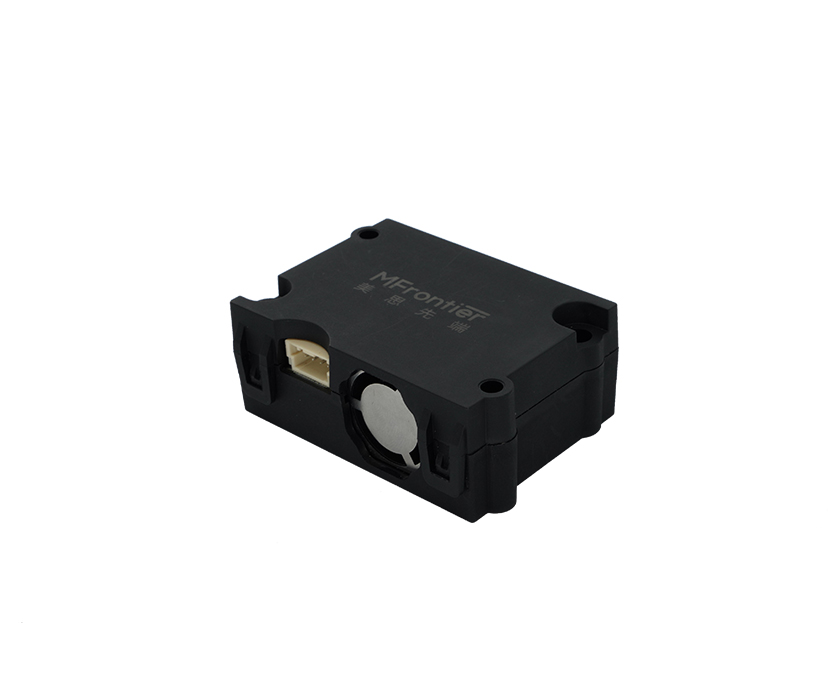
The sources of fine particulate matter inside a vehicle are far more complex than commonly imagined—ranging from road dust and tunnel exhaust to in-cabin smoking, dust accumulation in air conditioning ducts, and even microscopic fibers generated by friction against the seats. These minute particles—less than one-twentieth the diameter of a human hair—can bypass the nasal passages and throat to penetrate deep into the pulmonary alveoli.
The MFrontier automotive PM2.5 sensor employs the principle of laser scattering; utilizing a precision optical measurement chamber, it captures the light signals scattered by suspended airborne particles in real time. These signals are then processed via sophisticated algorithms to output precise PM2.5 concentration readings.
Its mission is unequivocal: to inform the vehicle exactly "what the current particulate concentration is." As these levels rise, the vehicle can use this data to determine whether to activate its air purification system or recommend that the windows be closed. The sensor itself does not make these decisions; rather, the data it provides serves as the foundational starting point for all automated air purification logic.
02 CO₂ Sensor: The Vigilant Guardian Focused on Carbon Dioxide Concentration
Inside a sealed vehicle cabin, every breath taken by the occupants consumes oxygen and releases carbon dioxide. During high-speed cruising or in extreme weather conditions—whether freezing cold or scorching hot—prolonged use of the internal air recirculation mode can easily cause the in-cabin CO₂ concentration to exceed 2,000 ppm within just 30 minutes. This level is sufficient to induce symptoms of fatigue in the driver, such as reduced concentration and slowed reaction times.
The MFrontier automotive CO₂ sensor utilizes Non-Dispersive Infrared (NDIR) technology. By measuring the degree to which infrared light of a specific wavelength is absorbed by CO₂ molecules, it precisely calculates the carbon dioxide concentration to determine whether in-cabin CO₂ levels have exceeded safe limits.
This monitoring data can be used to automatically trigger the air conditioning system to switch to external air intake, or it can be displayed intuitively on the central control screen to alert occupants that "it is time to ventilate."
03 Automotive 2-in-1 Sensors: A Space-Saving Solution Through Integrated Design
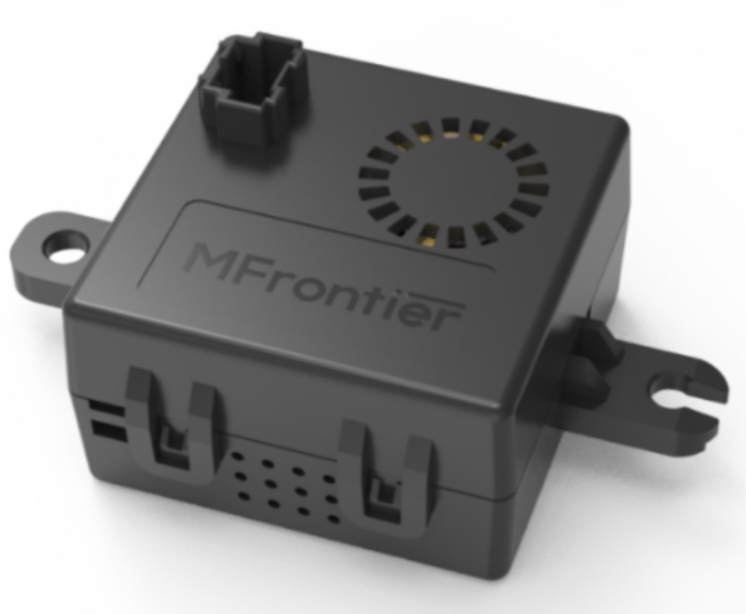
In automotive electronic systems, every cubic centimeter of space is precious. For vehicle models requiring simultaneous monitoring of both PM2.5 and CO₂, installing two separate sensors not only consumes more physical space but also entails higher wiring harness costs and more complex assembly procedures.
The MFrontier 2-in-1 PM2.5 and CO₂ sensor was developed to address this very need. It physically integrates two independent sensing units into a single package module. A laser scattering module handles particulate matter monitoring, while an NDIR chamber monitors carbon dioxide; although they share a common power supply and communication interface, their respective measurement and signal output processes remain entirely independent and non-interfering.
For automakers, this 2-in-1 sensor translates to: a single mounting point, a single wiring harness, and a single communication node—yet it delivers two sets of critical air quality data.
04 Refrigerant Leak Detection Sensor: A Dedicated Early Warning System for Refrigeration Line Leaks
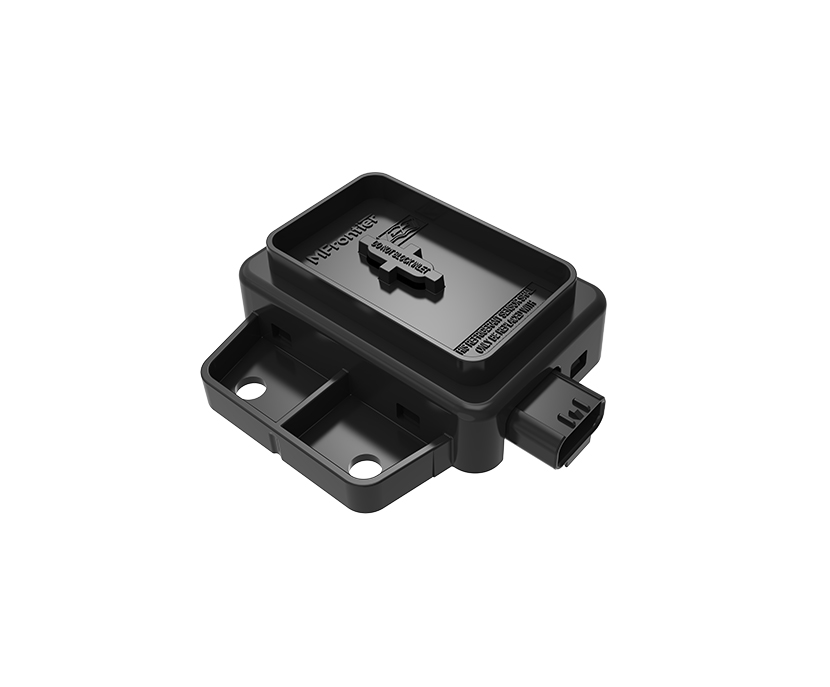
The air conditioning system serves as the core component for cabin comfort, while the refrigerant acts as the lifeblood of that system. A slow leak in a minuscule line often presents no immediate symptoms—cooling performance may decline only slightly, and the driver might not notice anything amiss for months. Yet, during this interval, the compressor may suffer accelerated wear due to insufficient lubrication, and the leaking refrigerant could also have an adverse impact on the environment.
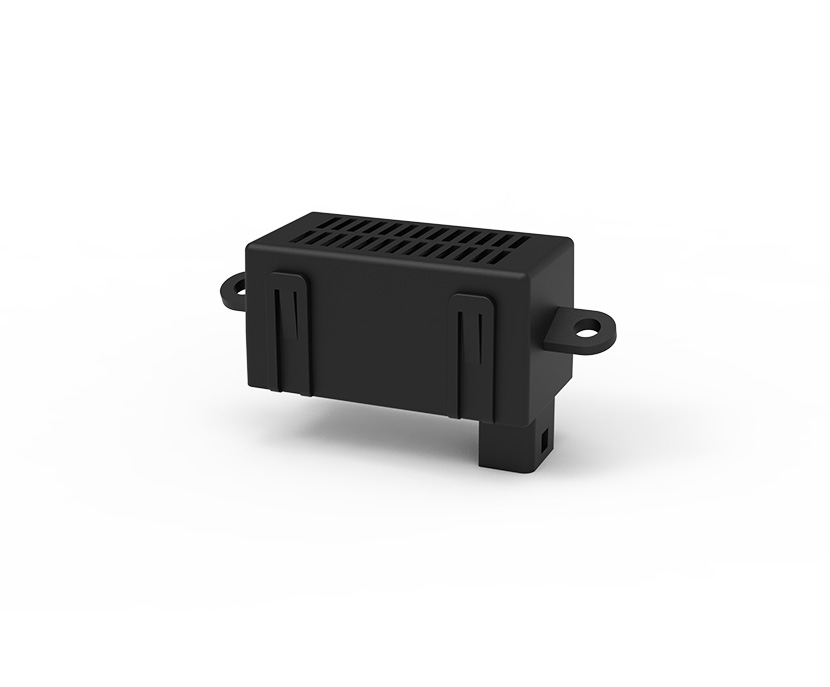
The MFrontier automotive refrigerant sensor is designed specifically to address this scenario. Its mission is to detect the presence of refrigerant leaks within the surrounding environment. Upon detecting an abnormal concentration level, it immediately triggers an alarm signal, alerting the vehicle owner to schedule timely inspection and repairs.
Refrigerant leak detection sensors focus on ensuring the seal integrity of the thermal management system. In today's automotive landscape—where heat pump-based air conditioning systems in new energy vehicles are becoming increasingly prevalent—refrigerant monitoring is rapidly transitioning from an optional feature to a standard configuration.
05 Infrared Thermopile Array Sensors: Unlocking the Fifth Dimension of Temperature Field Sensing
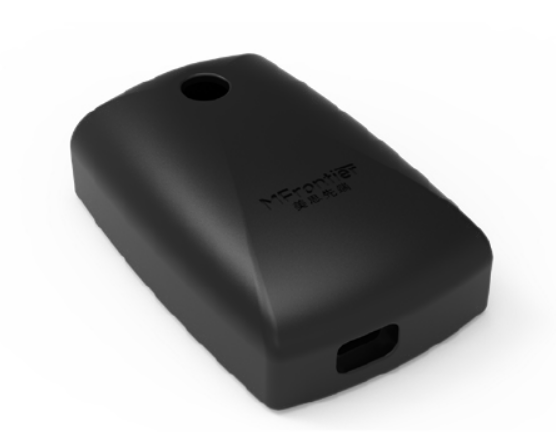
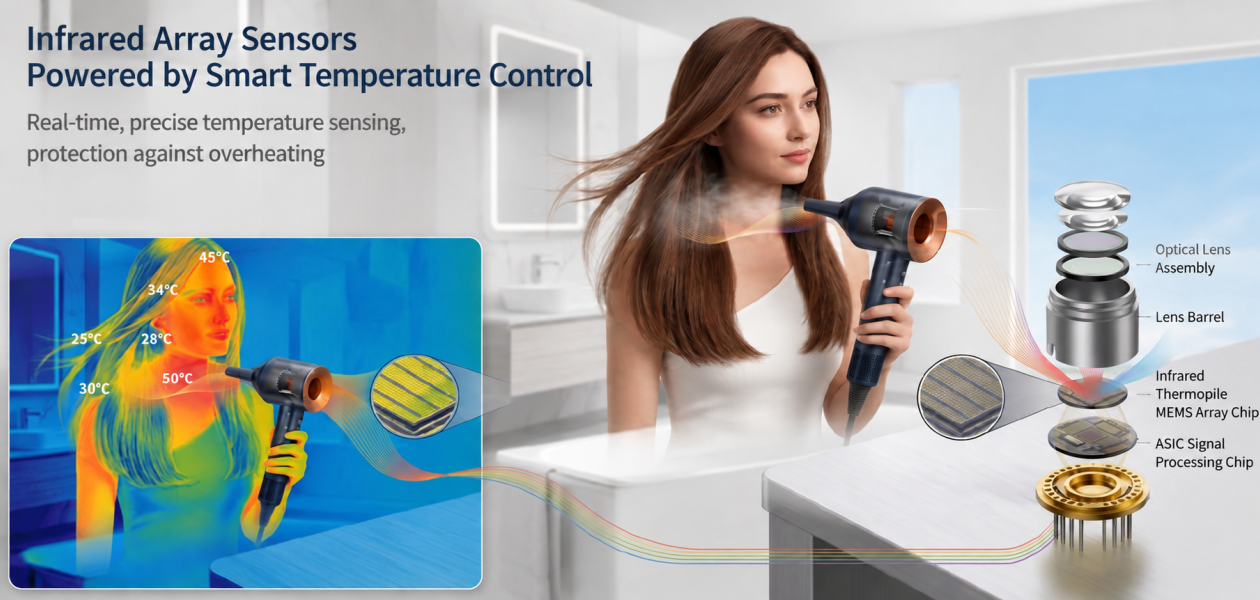
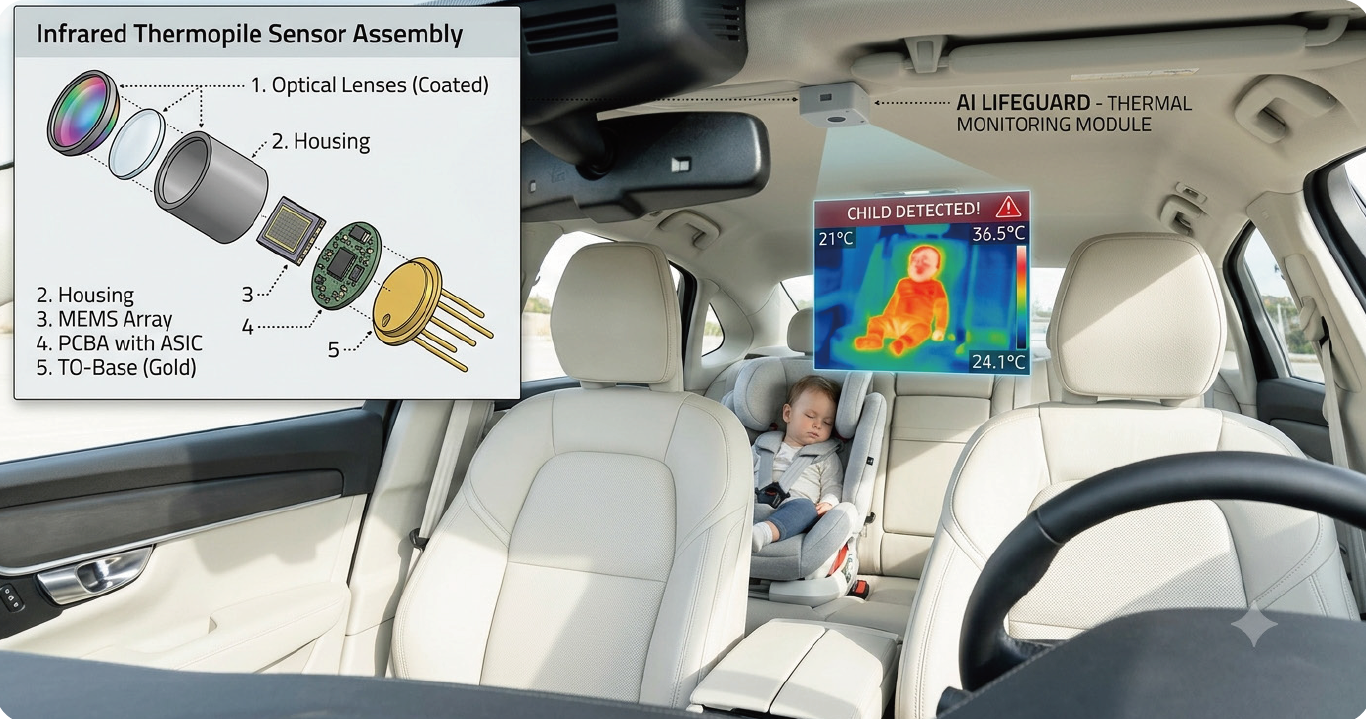
If air quality sensors monitor the "chemical environment" of the cabin, then MFrontier’s thermopile array sensors—built upon CMOS-MEMS technology—forge an entirely new "physical dimension" of cabin sensing: high-precision, non-contact measurement of temperature field distribution.
A technological gap has long existed between expensive microbolometers (used for high-end thermal imaging) and simple single-element infrared sensing devices; the market requires a low-cost, high-precision, non-contact temperature measurement solution capable of covering a specific spatial area. MFrontier’s thermopile array sensors were created specifically to fill this need. Utilizing CMOS-MEMS processes, these sensors monolithically integrate high-performance thermopile arrays with readout circuitry, enabling highly granular perception of temperature distribution within the cabin.
Applications of Infrared Thermopile Array Sensors in the Automotive Cabin:
1. Occupant Sensing and Position Detection: Through infrared thermal imaging algorithms, the sensors precisely identify the position, contours, and even the posture (sitting or reclining) of occupants within the cabin. When combined with AI algorithms, they can determine "who is where"—even in total darkness—with an accuracy rate exceeding 96%. This provides the critical positional data required for HVAC systems to implement "follow-me airflow" (directing airflow toward occupants) and "avoid-me airflow" (directing airflow away from occupants) functions.
2. Occupant Presence Detection: When the vehicle is locked, the thermopile array sensors remain on duty independently. They can capture faint body heat signals within the cabin to accurately detect the presence of any left-behind children or pets. Compared to visible-light cameras, these sensors possess inherent advantages regarding static object detection and privacy protection.
3. Window Defogging Prediction: By continuously monitoring temperature fluctuations on the glass surfaces—and integrating this data with readings from the vehicle's independent humidity sensors (at the vehicle system level)—the sensors can utilize a dew point temperature model to predict the risk of fogging in advance, thereby triggering the automatic defogging function.
Working in Concert to Build a Foundation for Comprehensive Sensing
In the era of intelligent vehicles, cabin environment sensing is evolving from the monitoring of single parameters toward a multi-dimensional, integrated approach. Through its product matrix—comprising air quality sensors, refrigerant leak detection sensors, and infrared thermopile array sensors—MFrontier provides automotive manufacturers with flexible, independent sensing solutions. PM2.5 sensors continue to count fine particulates; CO₂ sensors track the byproducts of respiration; refrigerant sensors stand guard over the integrity of the vehicle's air conditioning lines; and infrared thermopile array sensors quietly monitor the distribution of thermal radiation within the cabin. It is precisely these independent, dedicated sensing nodes that construct a comprehensive perceptual foundation for the intelligent cockpit—spanning everything from respiratory safety to thermal comfort.
Share