
A crucial knowledge point for analog circuits is the operational amplifier (op-amp). Op-amp circuits are incredibly diverse and represent a vital part of analog circuit knowledge. Analyzing the working principle of op-amps without a grasp of their core principles can be daunting and confusing.
Based on my experience, I will analyze op-amp circuits using the most common op-amp characteristics: "virtual short" and "virtual open." These concepts are introduced in analog circuit textbooks and are very useful in all op-amp circuit analyses. However, mastering them requires considerable expertise.
(1) Virtual Short: A virtual short refers to the op-amp's non-inverting and inverting inputs appearing as a short circuit, but in reality, they are not. Therefore, it is called a "virtual short," meaning the voltage (potential) at the positive and negative inputs of the op-amp is equal.
(2) Virtual Open Circuit: The impedance at the op-amp input terminal is very high, and the current flowing in is very small, less than 1uA. Therefore, in calculations, the op-amp input terminal can be approximated as an "open circuit," hence the term "virtual open circuit." "Virtual open circuit" means that the current at the positive and negative input terminals of the op-amp is zero.
When analyzing the working principle of an op-amp circuit, focus on the concepts of "virtual short circuit" and "virtual open circuit," and then combine them with the circuit principle for calculation. This is very convenient and eliminates the need to memorize formulas for inverting amplifiers, adding amplifiers, subtracting amplifiers, differential inputs, etc.
The following example illustrates this:
(1) Inverting Amplifier:
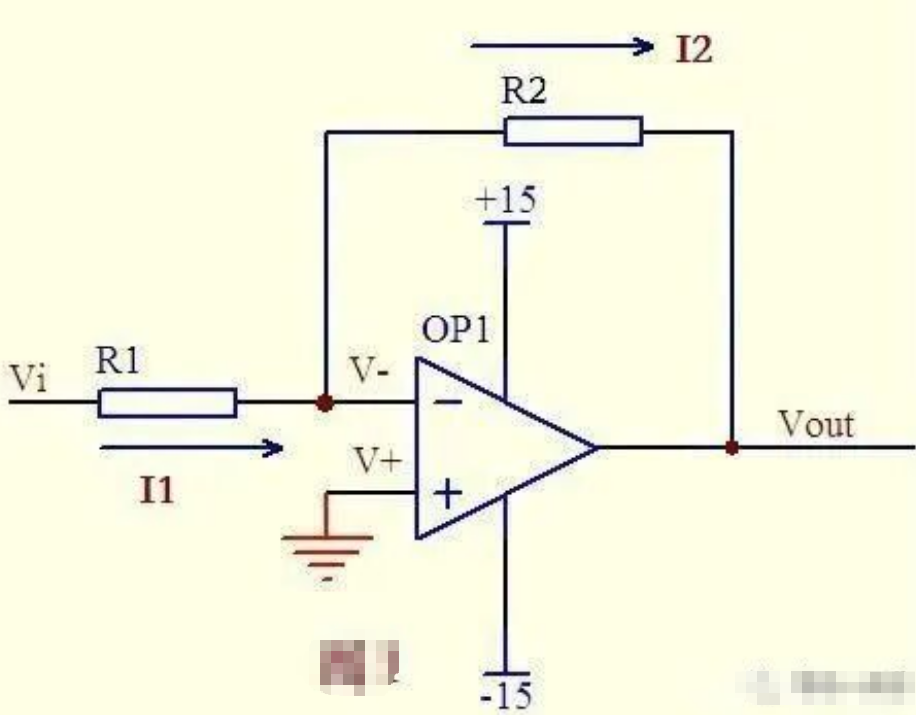
Figure 1
Figure 1 shows an inverting amplifier. ① From the concept of "virtual short," we get V+ = V-. ② From the concept of "virtual open," we get the current at the positive and negative input terminals of the op-amp is 0, so I1 = I2.
Since V+ = 0, V- = 0. Therefore, the current in R1 is I1 = (Vi - V-)/R1.
The current in R2 is I2 = (V- - Vout)/R2.
From I1 = I2, we get (Vi - V-)/R1 = (V- - Vout)/R2.
After simplification, we get: Vout = (-R2/R1)*Vi, which is the formula for the inverting amplifier.
(2) Non-inverting amplifier:
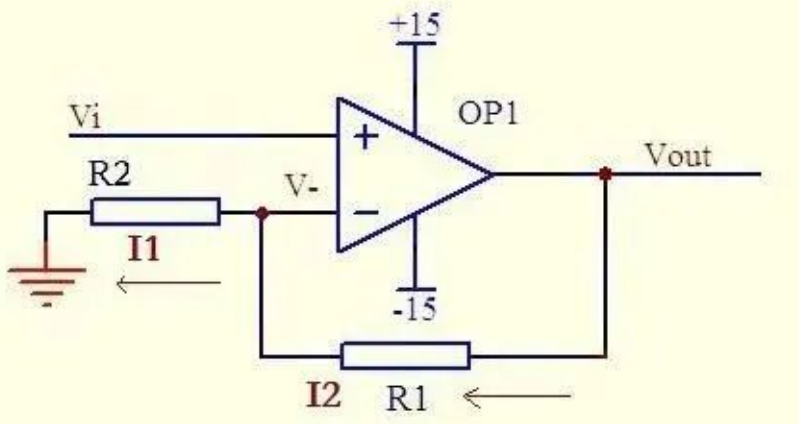
Figure 2
From Figure 2, ① based on the "virtual short," we get Vi = V-; ② based on the "virtual open," we get the current at the positive and negative input terminals of the op-amp is 0, i.e., I1 = I2.
I1 = (Vi - 0) / R2
I2 = (Vout - Vi) / R1
Therefore, (Vi - 0) / R2 = (Vout - Vi) / R1
Simplifying, we get Vout = Vi * (R1 + R2) / R2.
(3) Adder circuit:
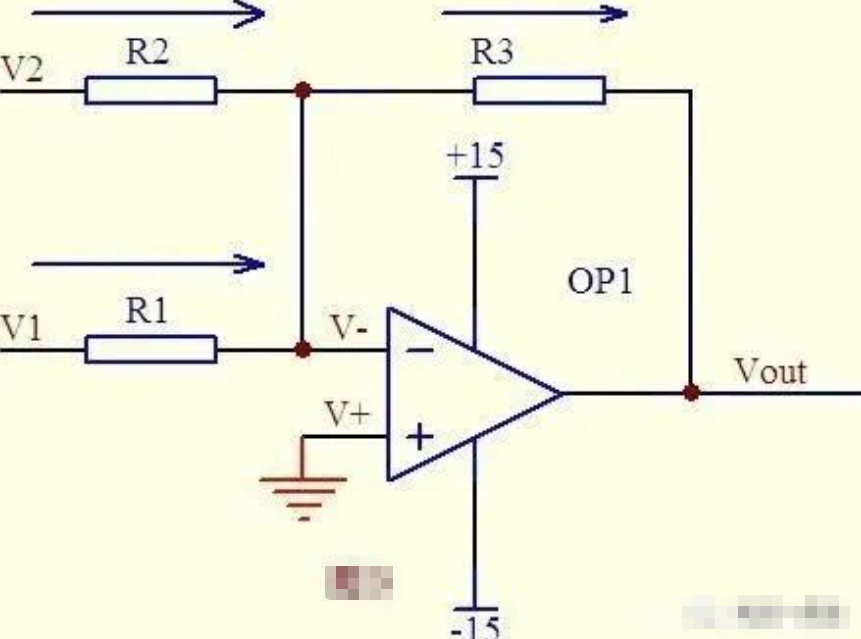
Figure 3
Figure 3 shows the inverting adder circuit. Similarly, ① based on the "virtual short," we get V+ = V- = 0;
② based on the "virtual open," the current at the positive and negative input terminals of the op-amp is 0, meaning the current in R3 is equal to the sum of the currents in R1 and R2.
(V- –Vout)/R3 = (V1 – V-)/R1 + (V2 – V-)/R2. Since V+ = V- = 0,
then –Vout/R3 = V1/R1 + V2/R2. If we take resistors R1 = R2 = R3, then Vout = -(V1 + V2).
(4) Differential amplifier circuit (subtraction circuit):
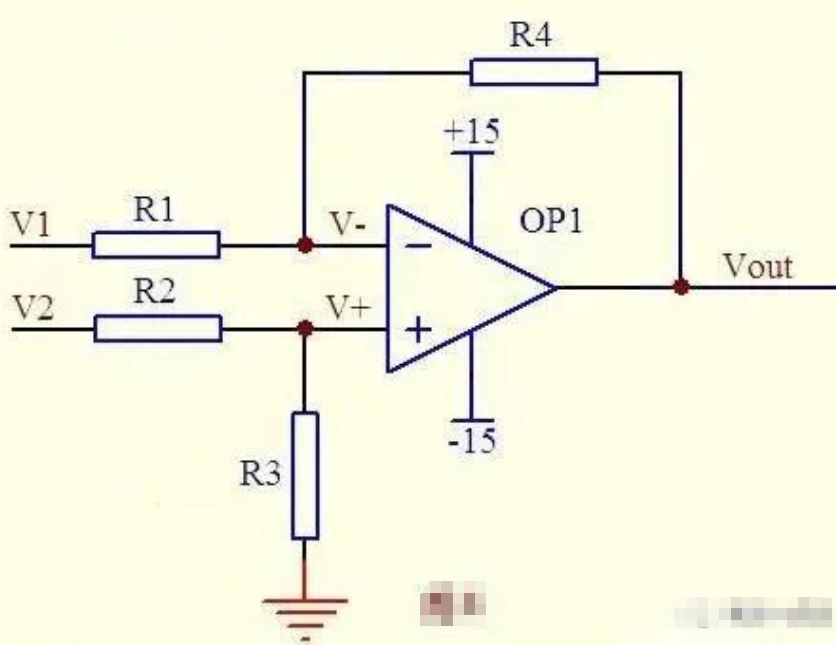
Figure 4
From Figure 4, similarly: ① based on the "virtual short," we get V+ = V-; ② based on the "virtual open," we get the current at the positive and negative input terminals of the op-amp is 0.
V+ = V2 * R3 / (R2 + R3)
V- = V+ = V2 * R3 / (R2 + R3)
Since the currents at R4 and R3 are equal, we get (V1 – V-) / R1 = (V- - Vout) / R4
Simplifying, we get Vout = (R2 + R4) * R3 * V2 / [(R1 + R4) * R2] - R4 * V1 / R2;
In practical applications, we generally take R1 = R2 and R3 = R4, then the input-output relationship becomes: Vout = (V2 - V1) × R4 / R1. If we take R1 = R4, then Vout = V2 - V1
Share