Introduction: Roger Grace Associates has been publishing its "MEMS Industry Commercialization Research Report" for 27 consecutive years since 1998. This highly influential expert research report in the global MEMS industry yields two key conclusions: the MEMS industry as a whole has entered the mature stage of its technology life cycle; and artificial intelligence is profoundly reshaping the market demand, capital investment, and talent landscape for MEMS sensors.

I. Report Background and Research Methodology
The *MEMS Industry Commercialization Research Report*, established in 1998, aims to directly address the various practical obstacles hindering the commercialization of MEMS technology from the laboratory. Moving beyond the traditional market report model that simply presents revenue data, it employs an expert-scored report card evaluation system, qualitatively assessing the entire industry based on 14 key commercialization success factors. It is a renowned qualitative industry survey in the global MEMS and sensor field.
The 2025 report (Issue 27) continues to utilize a modified Delphi expert survey method. From March to June 2026, questionnaires were distributed to approximately 100 senior industry practitioners, resulting in 39 valid responses and 46 original oral/written comments from experts. The participating industry thought leaders generally have over 25 years of experience in the MEMS industry, and all respondents have accumulated over 1000 person-years of industry experience, covering the entire industry chain from R&D, manufacturing, capital, market, supply chain, and talent employment perspectives. The survey assigned an A-F rating to 14 key commercialization indicators, requiring experts to provide detailed reasoning behind each score, thus retaining a wealth of firsthand industry insights. The final report was a 44-page document.
II. Core Rating Results: The MEMS Industry Enters a Mature and Stable Phase
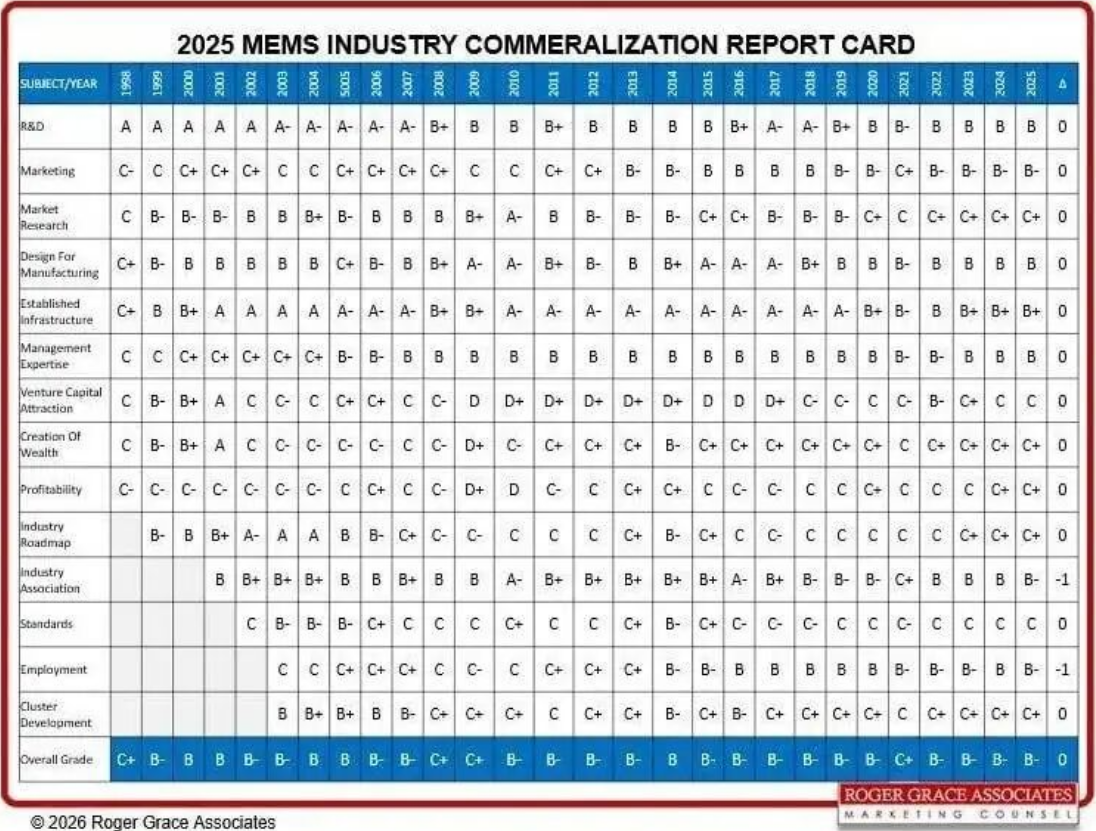
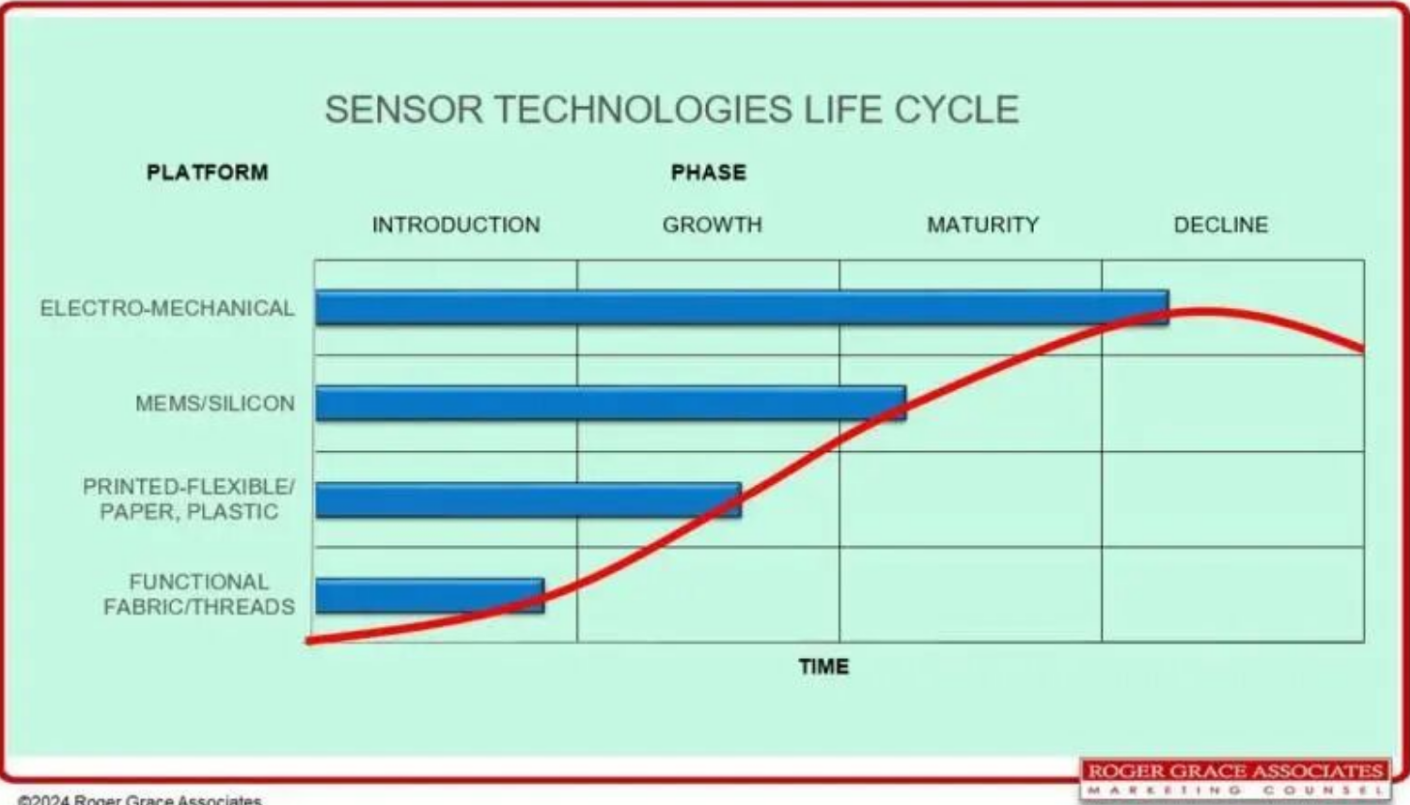
This survey gave the industry an overall rating of B-, a rating maintained for four consecutive years and representing the final score for 10 out of the past 11 years. Only in 2021, impacted by the COVID-19 pandemic, did the rating briefly drop to C+, before quickly recovering to B- in 2022. This demonstrates the strong resilience of the MEMS industry and signifies that MEMS has completed its introduction and growth phases, officially entering the mature stage of its technology lifecycle.
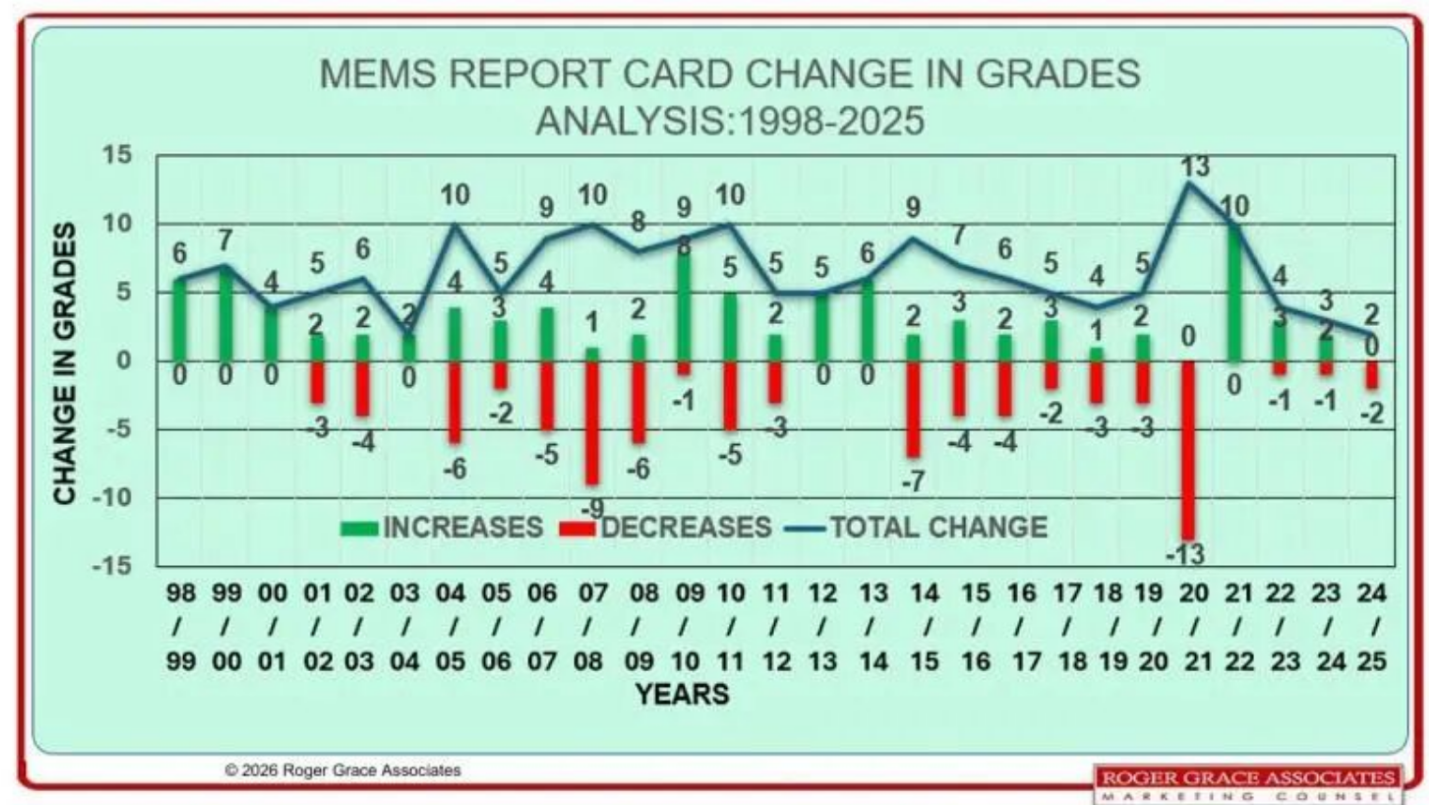
Looking at the 14 sub-indicators, only two ratings were downgraded in 2025: the industry association dimension dropped from B to B-, and the employment dimension also dropped from B to B-. The remaining 12 indicators maintained their original ratings. Comparing historical data, socioeconomic crises typically lead to significant rating fluctuations. During the economic downturn of 2008-2009 and the COVID-19 pandemic of 2020-2021, more than ten indicators were downgraded annually. In contrast, during periods of stable industry maturity, only 2-3 indicators change annually, with only 2 indicators expected to change in 2025, further confirming a more stable industry landscape. The report suggests that as a technology transitions from its growth phase to maturity, companies' marketing strategies need to evolve accordingly. It recommends shifting industry marketing from a traditional science education approach to a pragmatic "problem-solution" narrative.
III. Biggest Change: The Explosion of AI Topics, Reshaping the MEMS Industry Landscape
A keyword analysis of all original expert comments reveals a trend that warrants serious attention: the number of AI-related mentions in the survey texts has exploded, from only 1 in 2023 to 10 in 2024, and soaring to 20 in 2025. In stark contrast, mentions of the US Chip Act have steadily declined, from 5 in 2023 to 4 in 2024, and only 1 in 2025.
The report includes numerous genuine opinions from industry experts, vividly showcasing the changes taking place in the MEMS industry under the AI wave. Experts generally believe that AI creates enormous sensing demand, and the demand for sensors across all platforms is directly linked to the explosive growth of AI computing power. MEMS sensing capabilities should rightfully be the core focus of the industry's external communication; however, a real contradiction has also emerged: government, university, and social resources are heavily skewed towards AI talent development, squeezing resources allocated to training semiconductor and MEMS industry workers. Capital investment has also shifted, with less funding going towards the R&D of underlying processes for new MEMS devices and a significant amount shifting towards system integration, AI sensing, and vertical application solutions. While MEMS product applications continue to proliferate, the job market for MEMS engineers is being squeezed by AI and software-related positions. However, opportunities also objectively exist. Customizing application roadmaps around AI needs can secure substantial industry funding, and the industry is also considering whether AI+MEMS can drive the large-scale adoption of hearing-enabled wearable devices.
The report draws an analogy between the current relationship between AI and MEMS and the 1980s: the widespread adoption of microprocessors drove double-digit growth in MEMS devices; today, the proliferation of artificial intelligence is replicating this historical process, particularly driving demand for MEMS sensors in wearable devices. The report emphasizes a fundamental logic: without sensors collecting data from the real physical world, the value of AI models is severely limited; MEMS sensors are the foundation for AI's interaction with the physical world. The recently concluded Sensors Converge 2026 conference agenda also confirms this trend, with AI becoming a frequently discussed topic throughout the sensor field and a core driving force for the deployment of low-cost, high-volume MEMS devices in emerging scenarios.
IV. Exposed Shortcomings: Downgrades in Industry Associations and Employment Indicators
The report highlights two key areas where scores were lowered, revealing hidden risks in the mature MEMS industry. First, the downgrade in industry association ratings reflects room for improvement in areas such as technological collaboration, standards development, and industry communication. Second, the downgrade in employment indicators aligns with expert commentary; the AI boom is siphoning off talent, diminishing the attractiveness of MEMS hardware engineers. While recruitment has shown a slight recovery, a talent shortage remains a significant issue. The industry's maturity does not automatically guarantee continued high growth; talent and the industry ecosystem remain critical bottlenecks hindering future innovation.
V. Insights and Industry Reflections
This 27th MEMS Commercialization Report Card offers several insights for domestic MEMS and sensor professionals. First, MEMS has moved beyond its period of unchecked growth; the era of simply competing on device performance parameters is over. System integration and problem-solving for downstream applications will become the core of competition. Second, AI is not a replacement for sensors, but rather an amplification of their market value. Large-scale AI models require MEMS sensing hardware as a physical entry point. The fusion of "MEMS sensors + AI" will become a crucial sector, but we must be wary of excessive capital investment in upper-level algorithms, leading to insufficient investment in original innovation for underlying MEMS devices. Finally, the talent shortage needs attention. The AI boom is squeezing out hardware talent; the domestic MEMS industry needs to improve interdisciplinary talent training and balance the talent pool for algorithm software and micro/nano hardware.
Source: Roger Grace. Roger Grace MEMS report validates the rising role of AI, Fierce Sensors, 2026-08-06.
Share